Start with the way the piece should behave
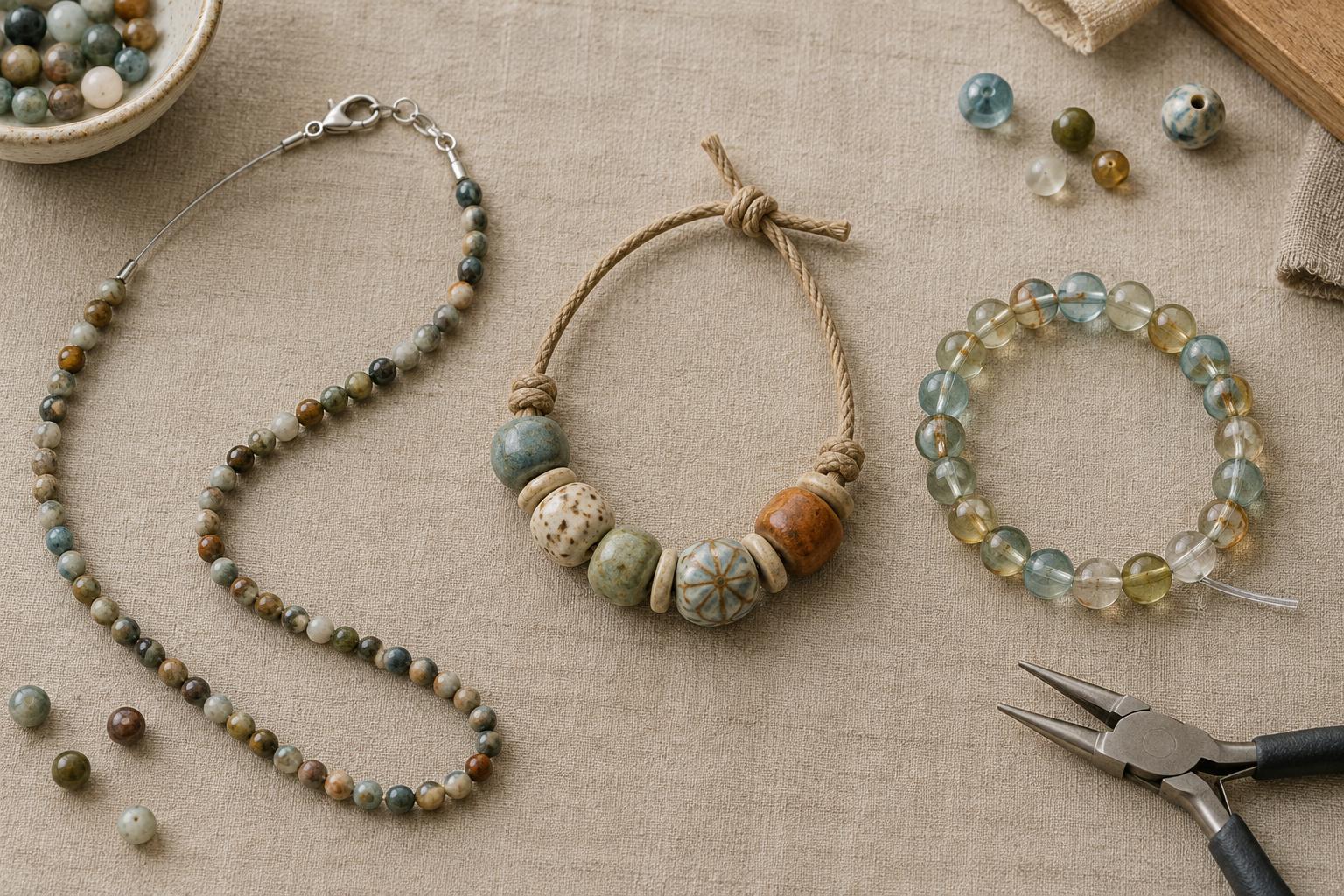
A stringing material does more than hold beads together. It influences the shape of a necklace, the movement of a bracelet and the way a finished piece goes on and off. Before choosing one, picture the finished jewellery: should it curve neatly around the body, hang in a soft line, show visible knots between beads or slip over the hand without a clasp?
Then examine the beads themselves. Their weight, hole size and hole edges all matter. A stringing material must pass through each bead, sometimes more than once at the ends, without being forced. Rough holes can wear through cord, coating or elastic over time. If a bead has a sharp inner edge, consider whether a different bead, a suitable liner or a different construction would make the piece more reliable.
Choose coated beading wire for a flexible, clasped strand
Beading wire is usually made from fine metal strands inside a protective coating. It is useful for many strung necklaces and clasped bracelets because it supports a row of beads while bending around the body. It is not the same as solid wire used to form loops or links: beading wire is intended to flex, not to hold a sculpted shape.
Beading wire comes in different diameters and constructions. A thinner wire may fit small bead holes, while a more flexible construction may help a strand fall smoothly. Neither feature should be considered in isolation. Choose a wire that fits the beads and suits their weight, then lay out a short test strand to check its drape. A strand that looks stiff on the table may feel awkward when worn.
The ends normally need appropriate crimps and findings rather than ordinary knots. Check that the crimp size suits the wire, and follow the crimp and tool instructions so the connection grips without cutting into the coating. Avoid tight bends near the clasp; a gentle curve gives the wire room to move.
Use cord when the stringing material is part of the design
Cord offers a different look and feel. Silk or nylon thread can suit beads separated by decorative knots, while cotton, waxed cord or leather cord can be deliberately visible in a more casual design. These materials do not behave alike: some are smooth and supple, some are textured, and some can stretch or change feel with handling and moisture. Select the particular cord for the effect you want, not simply because its stated thickness fits the bead.
Think through the finishing method before stringing. A knot needs enough room to sit securely, and a clasp or end finding must suit the cord’s diameter and surface. If you plan to pass the cord back through beads, test that path first; a doubled section can be much thicker than a single strand. With small beads, use a short sample to check whether the cord travels through the holes freely.
Cord may show wear where it rubs against hard or rough beads. Knotted sections, attachments and areas near the clasp are worth inspecting as the piece is worn. Visible fuzzing, thinning or slipping knots are signs to restring before the piece is used again.
Reserve elastic for pieces that need to stretch on
Elastic makes a clasp-free bracelet convenient, but that convenience changes the design requirements. The bracelet must expand enough to pass over the hand and recover well enough to sit comfortably at the wrist. Beads that are very heavy, sharp-edged or tightly packed can put extra strain on the elastic and its join.
Check that the elastic passes easily through every bead, including any beads you intend to use to conceal the knot. Follow the material maker’s guidance for preparing and tying it, since different elastics may call for different handling. Test the finished join with gentle, repeated stretching before wearing the bracelet. If possible, position the knot inside a bead with a hole large enough to hold it without scraping it.
Elastic is a consumable part of a piece of jewellery. Heat, repeated stretching and everyday wear can gradually reduce its resilience. A bracelet that becomes loose or shows damaged elastic is a candidate for restringing, even if its beads remain in good condition.
Make a small sample before committing
For an unfamiliar combination of beads and stringing material, a sample can answer several questions at once. String a few beads in their intended order, include a bend or knot where the finished piece will have one, and check how the sample hangs and moves. Look especially at the transitions between beads and at any area that will carry tension.
There is no single material that is best for every beaded piece. Coated wire is a practical choice for many flexible, clasped strands; cord gives you options for visible texture and knots; elastic enables a stretch-on design. Let the desired movement, bead holes and finishing method guide the choice, then inspect the completed piece as carefully as you chose its beads.