Start with the whole fastening
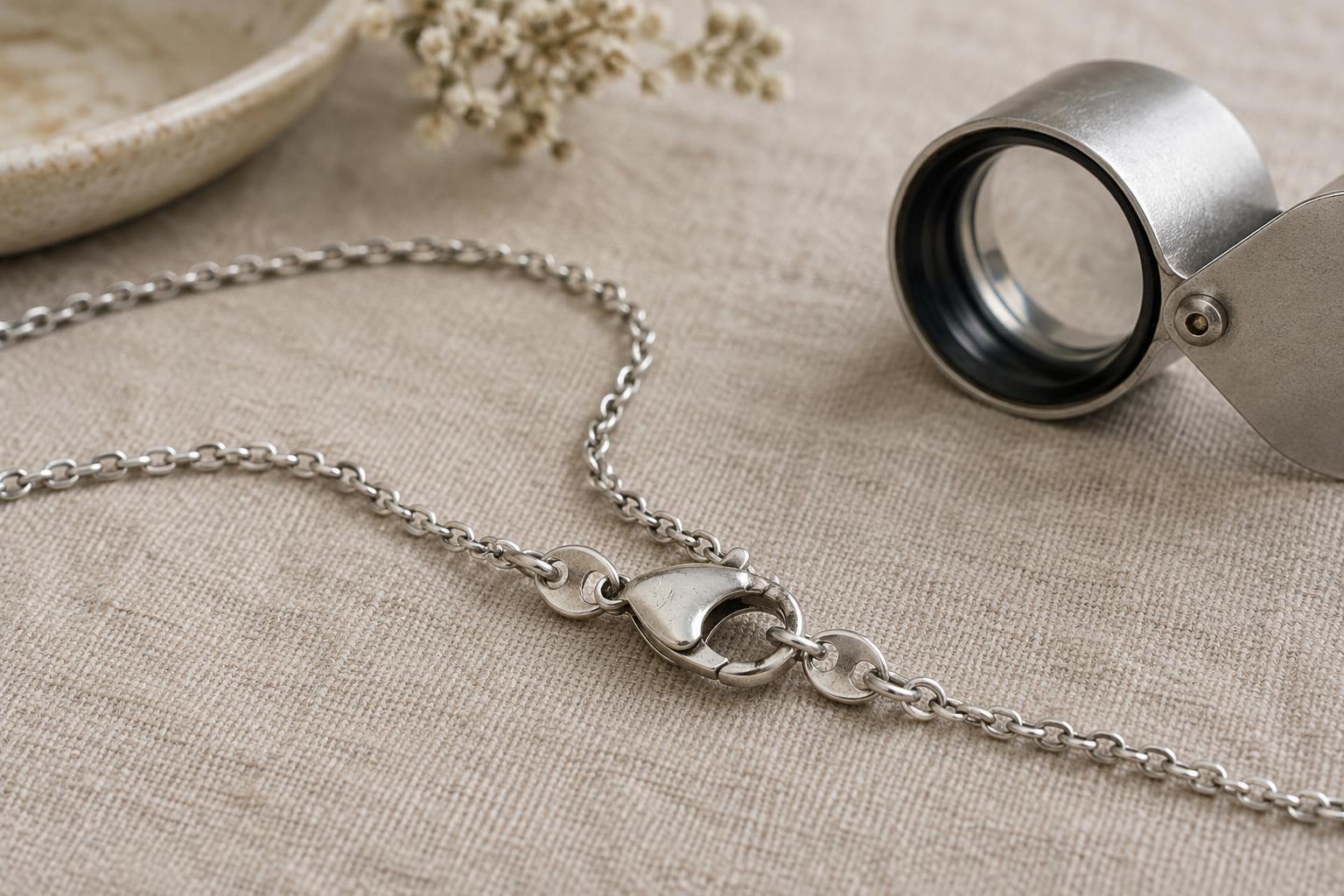
When examining a necklace, look beyond the clasp itself. The fastening includes the parts it connects to: an end ring, a short length of chain, a cord end or a beadwork loop. A clasp can close firmly yet still be attached through a worn or distorted connection. Hold the necklace over a soft surface while you inspect it, so a loose component is less likely to be lost.
Notice how easily you can fasten the necklace without pulling on its decorative sections. A tiny clasp may suit a delicate chain but be difficult to operate. A larger one can be easier to grip, although its weight may make it slide toward the front of a lightweight necklace. The right choice depends on the necklace’s construction as well as the wearer’s comfort.
Know what each clasp should do
A spring-ring clasp has a small lever that draws back part of a circular ring. A lobster clasp uses a similar spring action within a longer, rounded body. In either design, the moving part should return fully to its closed position when released. If it sticks, leaves a visible gap or requires repeated nudging, do not assume it will hold securely during wear.
A toggle clasp pairs a bar with a ring. To fasten it, the bar passes through the ring and rests across it. Toggles can be convenient, but their security depends partly on proportion and movement: a bar that passes too readily back through its ring may come undone when a necklace goes slack. A box clasp slides a shaped tongue into a housing, often with a small catch. Check that it engages without force and does not slip free under a gentle pull.
Magnetic clasps close when their two halves meet. They can be easy to use, but they may separate if snagged or pulled in the right direction. Treat ease of opening as part of your assessment, especially for a necklace that might catch on clothing. For any clasp, test it with a light, controlled tug rather than a sharp pull.
Inspect the connections, not just the mechanism
Look closely where the clasp meets the necklace. On a chain, an end ring may be soldered closed or formed from wire with a small opening. If an unsoldered ring has shifted out of alignment, its ends can create a gap. On a cord necklace, check whether the cord sits firmly in its end fitting and whether the material near the fitting is frayed or compressed. On beadwork, inspect the thread or wire where it passes through the final beads and fastening.
Compare both ends of the necklace. One side may show more wear because it is handled more often. Uneven links, stretched loops, sharp edges and a clasp that sits at an odd angle are reasons to pause before wearing the piece. Discolouration alone does not establish that a connection is weak, but a change in shape or a newly visible gap deserves closer attention.
If a fastening seems unreliable, set the necklace aside rather than trying to prove its strength with a hard pull. A simple component may be replaceable, but repair needs depend on the materials and construction. Plated finishes, delicate chain and older beadwork can be damaged by an unsuitable tool or an improvised fix.
Make checking part of ordinary care
A brief check before wear is more useful than waiting for a clasp to fail. Open and close it once, confirm that the moving part returns to position, and look at both attachment points. After wearing, lay the necklace flat and separate it from pieces that could catch on its chain or fastening. If you notice a change, make a note of it so you can describe the problem clearly when seeking a repair.
It also helps to distinguish a fastening problem from a fit problem. A necklace that twists, feels too short or repeatedly brings its clasp to the front may need an adjustment rather than a new clasp. Observing when the problem occurs can make the next step clearer without risking the piece.
For further browsing beyond craft care, explore Public Services Explained · Community Support Explained for public-service topics, Finding Official Information · Community Support Explained for guidance on finding official information, and Community Support Explained for broader community-support reading.