Why the edge is worth a closer look
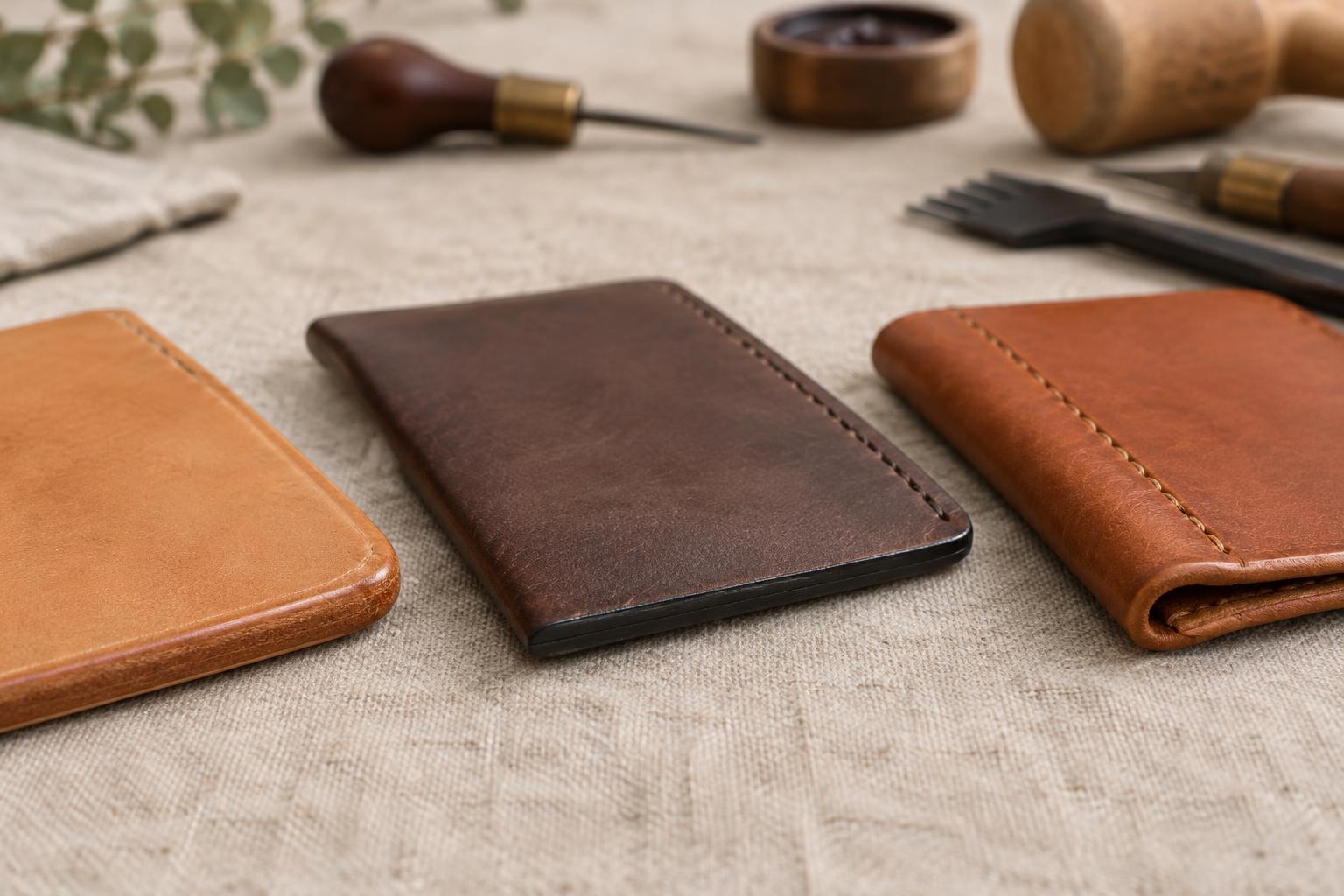
On a wallet, belt or small bag, an edge may look like a minor detail. It is also where the cut layers, lining and construction choices become easier to see. Makers can leave an edge exposed, smooth and seal it, cover it with a coating, or turn the leather over so the cut edge is hidden. These approaches create different appearances and respond differently to wear.
Examine an edge in good light, including a corner and a place that bends during use. Look from the side rather than only from above. Colour, surface texture and the shape of the edge offer clues, but no single clue is conclusive: a dark burnish can resemble paint, and a folded edge may also have a small painted seam elsewhere on the same object. There is no need to scratch or peel a finish to identify it.
Burnished edges: a smoothed cut surface
A burnished edge begins as a cut edge that has been worked until its fibres lie flatter and its surface feels smoother. The maker may trim and sand the edge before rubbing it with a tool and using an appropriate burnishing aid. The result is often a compact, gently rounded edge with a sheen rather than an obvious layer sitting on top. Some leather, particularly firm vegetable-tanned leather, lends itself readily to this treatment; other leathers may need different finishing methods.
Look closely at a worn corner. On a burnished edge, you may see the leather’s fibres or the faint boundaries between joined layers beneath the smooth surface. Its colour can be close to the leather’s natural cut colour or deliberately darkened. It need not be glossy: a well-smoothed matte edge can also be burnished. If the surface wears down, it may become slightly fuzzy rather than flaking away as a distinct film.
Burnishing does not necessarily conceal a layered construction. A thick belt may show one broad band of leather, while a wallet edge may reveal several pieces brought level and finished together. Slight variations in colour or shape are possible, though neither variation nor perfect uniformity proves how the edge was made.
Painted edges: a coating over the cut
Edge paint is applied to a prepared cut edge to form a covering. It can give thin or layered pieces a consistent colour and a defined outline. The coating may match the leather or provide contrast, so colour alone is not a reliable test. Look instead for a continuous, sometimes slightly raised band that sits over the cut surface. Under angled light, it may appear more uniform in texture than the leather beside it.
At corners or high-contact points, wear may reveal another useful clue. Paint can develop a small chip, a crack or a line where the coating lifts from the material below. This is not inevitable, and an intact painted edge may remain hard to distinguish from a carefully finished burnish by sight alone. A painted edge can feel smooth and rounded too; it is the presence of a separate covering, not smoothness, that defines it.
Do not treat visible layer lines as proof that an edge is unpainted. Thin coats can leave some underlying structure apparent, while thicker coats can disguise it. Comparing several areas of the same object, especially an inside corner and an exposed outer edge, usually tells you more than inspecting a single spot.
Folded edges: the cut edge is tucked away
A folded, or turned, edge is made by taking the leather over an edge and securing it on the reverse side or beneath a lining. From the outside, you see the leather’s finished face continuing around the curve rather than an exposed cut surface. This often creates a soft-looking rim or a slight change in thickness. On a slim item, the leather may be thinned near the fold to reduce bulk.
Trace the surface around the edge with your eyes. If the visible face wraps continuously around it, a fold is likely. The reverse side may show where the turned leather ends, although a lining can hide that junction. Stitching near the rim may help hold the construction together, but stitching alone does not identify a folded edge: painted and burnished pieces can be stitched as well.
A folded edge can still have cut edges at a strap end, pocket opening or internal seam. Leather goods frequently combine finishes to suit different parts of the object. Identify the particular edge you are examining rather than assigning one finish to the entire accessory.
Care and what the finish can tell you
For any edge, start with gentle handling: wipe away dry dust with a soft cloth, avoid prolonged soaking, and let a damp item dry away from direct heat. Do not pull at a lifted coating or pick at loose fibres. A peeling painted edge may need specialist refinishing, while a roughened burnished edge may sometimes be smoothed again by someone familiar with the leather. Adhesives or coatings applied without knowing the original finish can make a later repair harder.
An edge finish is a construction choice, not a simple quality ranking. Burnishing highlights a worked cut edge, paint offers a covered outline, and folding hides the cut within the construction. The most useful question is whether the finish suits that part of the object and remains sound where it flexes and rubs. Looking at several edges, rather than judging by shine or colour alone, gives you a more reliable answer.