Start with what the closure needs to do
A closure is more than a finishing detail. On a wallet, pouch or small bag, it determines how quickly you can get inside, whether the opening stays covered and where repeated stress falls on the leather. A closure that suits a slim card case may be frustrating on a pouch you open throughout the day.
Before comparing hardware, picture the object in use. Will it hold loose coins or just cards? Does it need to stay shut when turned upside down? Can you operate it comfortably with one hand? Also consider how full the item will be. An overfilled pocket puts tension on any fastening and may cause the leather around it to stretch.
Construction matters as much as the type of closure. Look for an opening that meets evenly, hardware that sits flat and enough leather or lining around attachment points to resist pulling. On a handmade item, small differences in placement can affect both ease of use and long-term wear.
Snaps: compact and quick
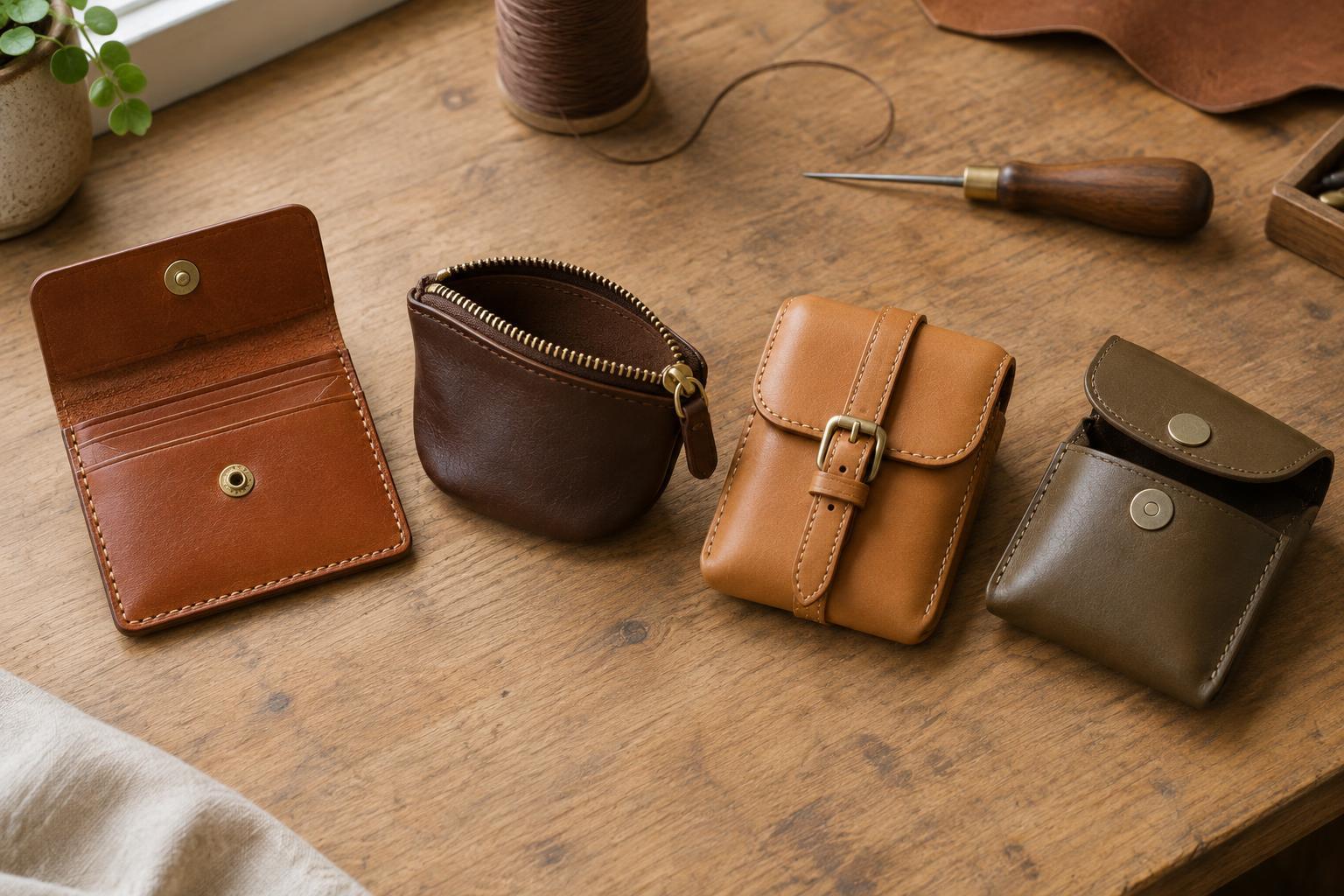
Snaps work well on flap wallets, key cases and small pouches where a quick, positive fastening is useful. They take up little space and give a clear indication when engaged. Their main limitation is capacity: a snap set for a slim, empty item may become difficult to close once the item is packed.
Opening a snap pulls on the area around its two halves. A well-supported flap makes it easier to grip the hardware without tugging hard on the leather edge. Check that the parts meet without forcing the flap sideways and that the snap feels secure without requiring an excessive pull. If the leather puckers around the hardware, the setting or reinforcement may not suit that material.
A damaged snap can sometimes be replaced, but removal may mark or enlarge its original hole. That is worth considering on a small accessory where there is little room to move the fastening.
Zips: containment along the whole opening
A zip is a strong choice when small contents must not slip out, particularly in coin purses, travel pouches and organisers. Unlike a single fastening point, it closes the length of the opening. The trade-off is that it adds bulk and can limit how widely the item opens, depending on how the zip is sewn in.
Try the zip through its full travel. It should move without snagging the lining or scraping against a thick leather edge. Look at the ends as well as the teeth: the stitching, tape and end stops all help the closure function. If the pouch is often stuffed, strain at the corners can make the zip harder to operate even when the zip itself is sound.
Zips have several parts that can wear or fail, including the slider and tape. Some repairs are straightforward; replacing an entire zip may require opening seams. Keeping grit out of the teeth and avoiding force when the slider catches can help prevent avoidable damage.
Buckles: adjustable but slower
A buckle suits a strap that needs adjustment, such as on a small shoulder bag or a wrap-style case. Multiple holes allow the closure to accommodate some change in thickness. A buckle also makes its fastening visible, so it is easy to check whether the strap is properly secured.
That adjustability comes with extra steps. Threading a strap through a buckle takes longer than closing a snap, and a long strap end needs somewhere to sit. Examine the holes for clean edges and enough surrounding leather to withstand repeated use. The strap should pass through the buckle without severe bending, and the buckle should not press awkwardly against the contents.
Buckles and straps may be repairable separately, depending on how they are attached. If ease of repair is a priority, look at whether the hardware is accessible or permanently enclosed within stitched layers.
Magnets and the final choice
Magnetic closures can make a flap easy to align and close with little effort. They are useful when convenient access matters more than a tightly sealed opening. Their holding power depends on the design, however, and a flap can shift or lift when the item is heavily filled or handled roughly. They are not a substitute for a zip when loose contents need to be fully contained.
Inspect how the magnets are fixed beneath or through the leather. Their positions should meet naturally when the flap rests in place; if you have to pull the leather into alignment, that tension will be repeated with every use. If you plan to carry an item that may be sensitive to magnets, check its maker’s guidance before choosing a magnetic closure.
There is no single best fastening. Choose a snap for speed on a compact flap, a zip for contained contents, a buckle for adjustment or a magnet for an easy-closing flap. Then test the actual item: open and close it several times, add what you expect to carry and notice whether the closure remains comfortable and secure.