Start with the structure of the hide
A hide is not uniform from surface to underside. Its outer portion contains the grain: a dense network of fibres that formed beneath the animal’s skin surface. Farther down, the fibres generally become looser. A thick hide may be separated horizontally into layers, allowing the grain-bearing upper layer and the lower split to be used for different purposes.
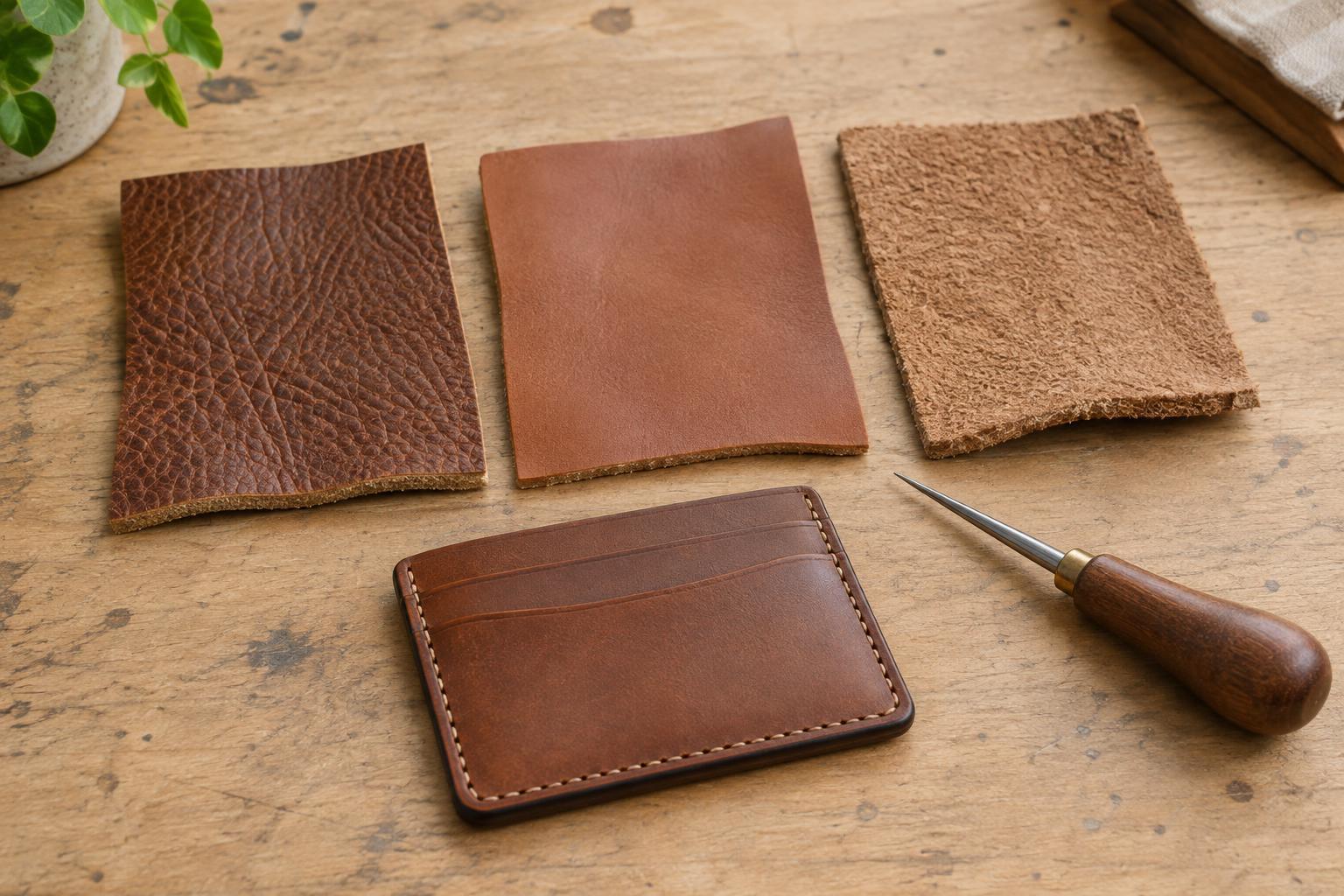
This structure explains much of the vocabulary on leather labels. Full-grain leather retains the original grain surface. Top-grain leather comes from the upper, grain-bearing portion of the hide; depending on how the term is used, it may include full-grain leather or refer to leather whose surface has been altered. Split leather comes from below the grain layer. These names identify starting material and processing choices, not a complete ranking of finished objects.
Full-grain: the original surface remains
Full-grain leather has not had its outer grain surface sanded away to remove marks. Natural variations, such as small changes in texture or colour, may therefore remain visible. The surface can be left relatively open or given a protective finish, so two full-grain pieces may look and feel quite different.
Because the grain layer remains intact, full-grain leather can be a good choice for an accessory that needs to withstand handling. Its performance still depends on the hide, tanning, thickness, finish and construction. Full-grain does not automatically mean soft, waterproof or free from maintenance. It also does not guarantee that every visible mark will develop into an attractive patina; wear depends on use and care.
Top-grain: a term that needs context
In a structural sense, top-grain means leather from the upper part of the hide, rather than a lower split. In product descriptions, however, it is often used for grain leather that has been lightly sanded, buffed or otherwise corrected to create a more even surface. A coating or embossed texture may then be applied. Since usage varies, the words “top-grain” alone do not reveal how much of the original surface remains.
Corrected-grain leather can be useful where a consistent appearance or a more stain-resistant finish is wanted. That finish may also change how the material feels and wears. A heavily coated surface can obscure the leather beneath it and may show damage differently from a less finished surface. Ask what finish has been applied if that distinction matters to you, rather than assuming that a neat, uniform appearance signals either good or poor quality.
Nubuck adds another distinction: it is typically grain leather whose surface has been buffed to produce a fine nap. Its soft, matte appearance should not be confused with the exposed underside of a split, even though both can have a velvety feel.
Split leather: useful, but different
Split leather lacks the hide’s original grain surface. When its fibrous face is finished with a nap, it can be sold as suede. Split leather may also receive a coating or embossed surface to give it a smoother appearance. The result can be attractive and suitable for particular uses, but it should not be mistaken for an intact grain layer.
For a frequently handled wallet, strap or bag corner, consider how the split’s thickness and finish suit the job. A thin or heavily coated material may be more vulnerable to abrasion at an exposed edge or repeated fold. Placement matters: a split used as a lining or protected panel faces different demands from one used on an outer strap. Bonded leather is another category altogether, made from leather fibres or pieces combined with binders; it is not simply a lower layer cut from a hide.
Judge the accessory, not just the label
When examining a small leather accessory, look beyond its surface. Check whether the material feels appropriate for parts that bend, whether edges are neatly finished, and whether stitching is even and secure at stress points. On a belt, inspect the holes and buckle attachment; on a wallet, pay attention to the fold and card-slot openings. These observations cannot identify a hide’s exact grade, but they reveal how thoughtfully the material has been used.
Care should follow the finish as well as the leather type. Remove loose dirt gently and test any cleaner or conditioner in an inconspicuous place, following the maker’s guidance when available. Avoid soaking leather or placing it against direct heat to dry. Suede and nubuck generally need different tools from smooth, coated leather. With a clear understanding of layers, finishes and construction, you can choose an accessory for how it will be used rather than relying on a single appealing label.