Start with what the mark is trying to describe
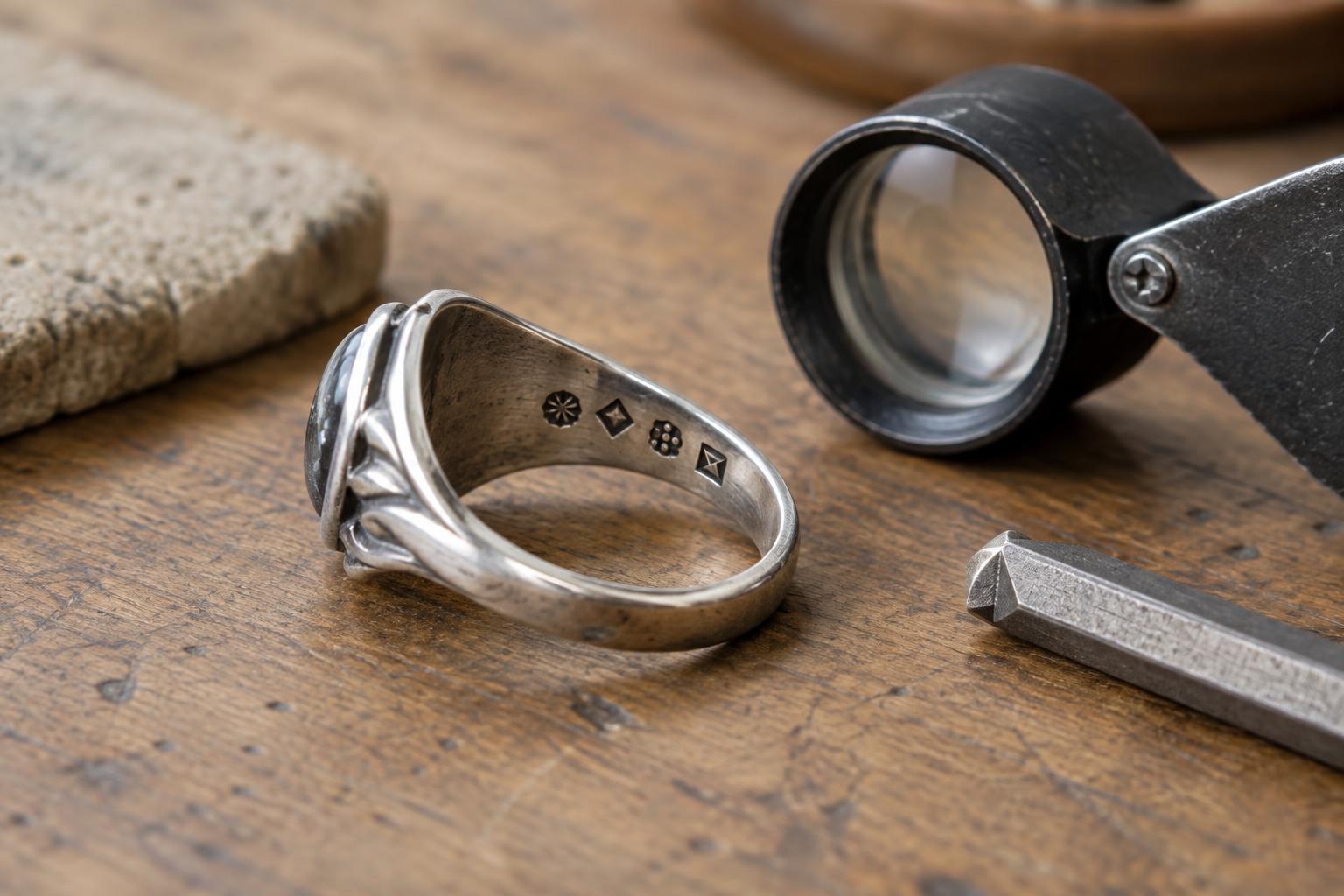
Turn over a brooch or look inside a ring and you may find a number, initials, a symbol or a pattern pressed into the surface. These impressions can look equally official at a glance, yet they serve different purposes. A hallmark is associated with a system for indicating precious-metal content and, depending on the place and period, may include other identifying symbols. A maker’s mark is intended to identify a person, workshop or business connected with production or submission for marking. A decorative stamp contributes to the design rather than certifying anything about it.
The distinction matters because no single impression is a complete biography of an object. Marking practices differ by jurisdiction and have changed over time. Before drawing a conclusion, consider where the mark sits, whether it forms part of a group of symbols, and whether it looks consistent with the object around it.
What a hallmark can—and cannot—establish
A hallmark may provide evidence about a precious-metal standard under a particular marking system. Some systems use a fineness number; others combine symbols for a standard, an assay office or a date. Those details only become meaningful when the correct system is identified. A number that resembles a fineness mark should not automatically be treated as a verified hallmark: it could be a manufacturer’s stamp, a later addition or a mark from a different convention.
Even a correctly interpreted hallmark does not tell you who designed a piece, where every component was made or whether the object is unchanged. A clasp, chain or decorative element may have been replaced. Marks can also be worn, obscured by a repair or copied. Conversely, an unmarked piece is not necessarily made of base metal; marking requirements and exemptions vary, and tiny components may offer little space for a legible impression.
Read a hallmark as evidence with a defined scope, not as a guarantee of every claim that might be made about an object. If the metal content matters for a purchase or repair, a qualified specialist can help assess the piece and explain what the visible marks support.
Why a maker’s mark is not always a signature
Initials or a small emblem can feel personal, but a maker’s mark does not always identify the individual who formed, set or finished the piece. It might refer to a workshop, company, retailer or registered party responsible for submitting the item for marking. Within one workshop, several people may have contributed to a finished object. A mark can therefore be a valuable lead without proving individual authorship.
Similar initials may belong to unrelated makers, and a business may have used more than one mark. Attribution depends on matching the mark’s exact shape and lettering with the relevant marking system, then checking whether the proposed identification fits the object’s construction. Without that context, it is more accurate to say that a piece bears a particular mark than to name a maker with certainty.
Decorative stamps and other impressions
Repeated dots, flowers, borders and geometric shapes are often made with punches or dies to add texture. A craftsperson may stamp a pattern by hand, while a manufactured component may carry a repeated impression from a machine process. Neither method, by itself, establishes the metal content or the age of the object. Look for how the impressions relate to the design: a motif repeated around a rim is more likely decorative than a small, separate group of symbols placed in an unobtrusive spot.
Other stamps can convey information without being hallmarks. A brand name, model or pattern code may identify a product line. Words describing a finish or metal layer are not the same as a verified precious-metal standard for the whole piece. Because marks can be abbreviated and local conventions differ, avoid assigning a fixed meaning to an unfamiliar stamp based on its appearance alone.
A careful way to examine a marked object
Begin with good light and a magnifier. Note the exact characters and symbols, their order and their position. Look across the whole piece, including the clasp and any detachable parts, for marks that differ. Photographing an impression from several angles can help reveal faint edges without polishing away useful surface detail. Avoid scratching or applying chemicals just to make a mark easier to read.
Then look beyond the stamp. Does the mark appear on a component that could have been replaced? Are joints, settings and wear reasonably consistent across the object? These observations cannot authenticate a piece on their own, but they can reveal questions a mark alone will not answer. Record what you can see separately from what you infer: “three initials stamped inside the band” is an observation; naming a workshop is an interpretation.
The most useful conclusion is sometimes a modest one. A mark may narrow the possibilities, suggest what to investigate next or explain why a seller’s description needs clarification. Treat hallmarks, maker’s marks and decorative stamps as different kinds of clues, and the object becomes easier to understand without asking any one impression to tell the whole story.