Two properties that do different jobs
Leather thickness describes the distance between its grain surface and underside. Firmness, often called temper, describes how readily it bends and how well it holds a shape. The two are related in use but are not interchangeable. A relatively thin leather can feel crisp and resist folding, while a thicker leather can feel soft and drape easily.
Both properties matter when leather becomes a small object. A wallet must close around cards and cash without feeling bulky. A pouch needs enough room for its contents and a mouth that opens comfortably. Choosing leather by appearance alone can hide a practical mismatch: a beautiful piece may be difficult to fold into a slim wallet or too limp for an upright pouch.
How thickness builds up in a wallet
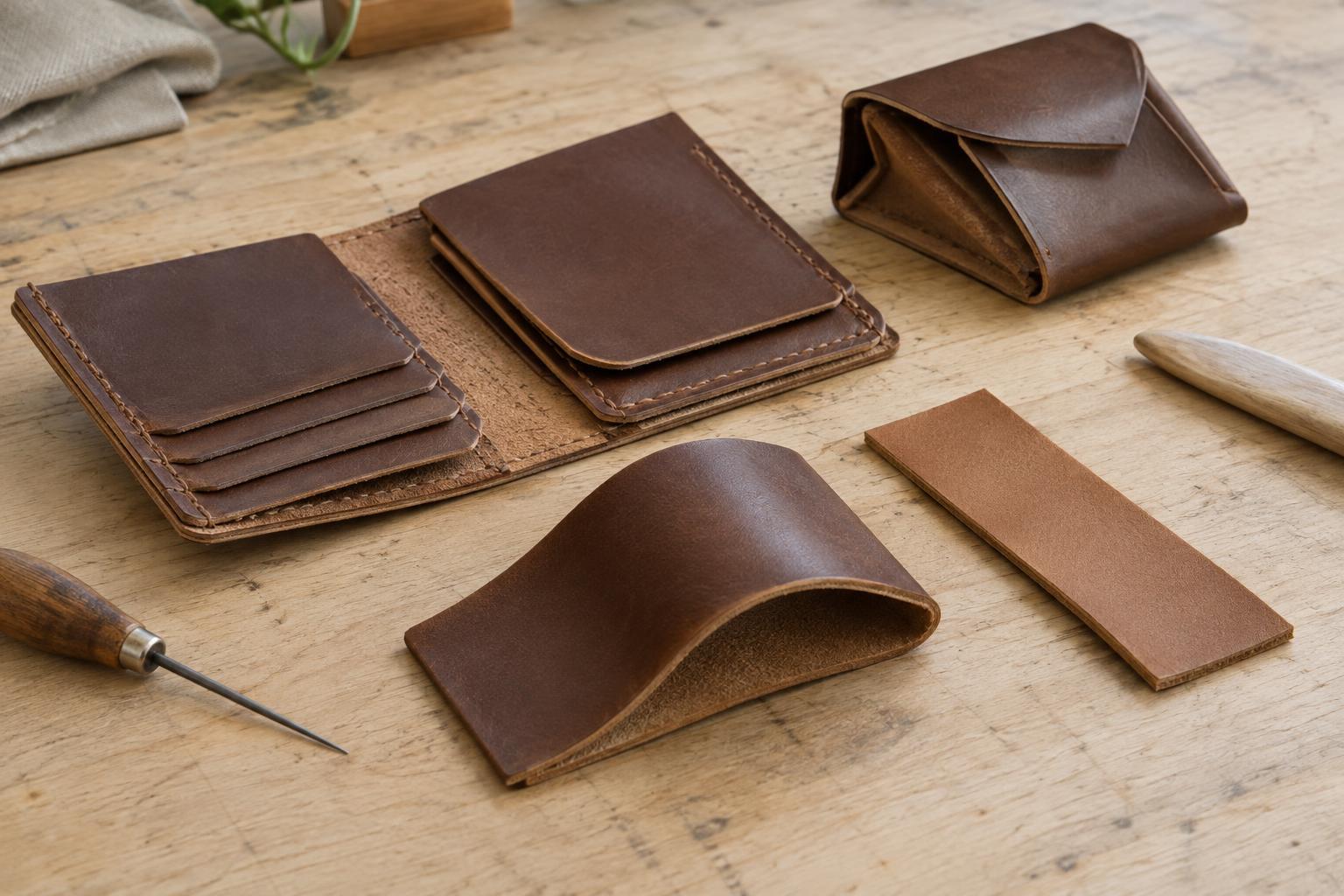
A wallet is not just one layer of leather. Card pockets overlap a backing panel, seams bring edges together, and folded sections stack when the wallet closes. Even modest thickness in each piece can add up. For a slim design, the maker may choose thinner leather for internal pockets than for the outer shell, rather than using one thickness throughout.
Thickness also affects how a fold behaves. A thicker panel needs more room to turn around the contents; if the pattern leaves too little allowance, the closed wallet may spring open or squeeze its pockets. A maker can sometimes reduce bulk by skiving, which means thinning leather in a selected area, such as a fold or seam allowance. Skiving needs care: removing too much material can leave an area weak or uneven.
A useful way to assess a finished wallet is to look at it from the side, both empty and filled with the amount you normally carry. Check whether its edges meet comfortably, whether cards slide in without excessive force, and whether the fold appears strained. These observations tell you more about the combined design than a thickness measurement on its own.
What firmness changes in a pouch
Firm leather helps a pouch keep a defined outline. It may suit a structured coin purse or small case whose opening should remain easy to find. Softer leather can make a drawstring pouch easier to gather and a casual pouch more comfortable to hold. Neither result is automatically better; the intended shape and closure determine which is useful.
A firm panel does not always need to be thick to stand away from its contents. Conversely, a soft, thick panel may collapse when the pouch is empty yet create bulky seams. The bottom and corners deserve particular attention. A pouch meant to sit upright may need a suitable panel shape, gusset or reinforcement, not merely firmer leather. A pouch designed to flatten for storage may benefit from a softer construction instead.
Firmness also influences access. Leather that strongly resists bending can make a narrow pouch mouth awkward to open, especially if the closure adds another stiff layer. Softer leather may open readily but sag around a heavy clasp. Handling a sample in the motion the finished object will make—folding it, gathering it or opening it—offers a better guide than judging it flat on a table.
Seams, edges and hardware need room
Thickness and firmness affect more than the main panels. At a seam, several layers may meet, making stitching difficult and producing a raised edge. A maker can address this through pattern placement, thinner pocket pieces or selective skiving. Edge finishing also depends on the construction: a thick exposed edge has a different feel and appearance from a thin, turned edge.
Closures introduce another layer of decisions. A snap needs an area that can flex enough for comfortable use while supporting the fastening. A zipper needs an opening and seam that can accommodate its tape without distorting the leather around it. Drawstrings work best when the opening can gather as intended. Matching the closure to the leather is more reliable than assuming a familiar wallet or pouch pattern will work unchanged in every material.
Choose for the finished object, not a single number
If you are comparing designs, start with what the object must do. For a wallet, consider how many pockets you need, how it should feel when filled and whether it must fit a particular pocket or bag compartment. For a pouch, consider the size and weight of its contents, whether it should stand, flatten or gather, and how often you will open it.
Then examine how thickness and firmness work together across the object. Look for manageable layer buildup, folds that close without obvious strain, and openings that move comfortably. Leather can soften and change character with handling, but it is sensible to choose a design that functions well from the start rather than relying on wear to correct a poor match. The most successful small accessory uses each property where it helps: enough substance to support its shape, and enough flexibility to make it pleasant to use.