Start by identifying what has changed
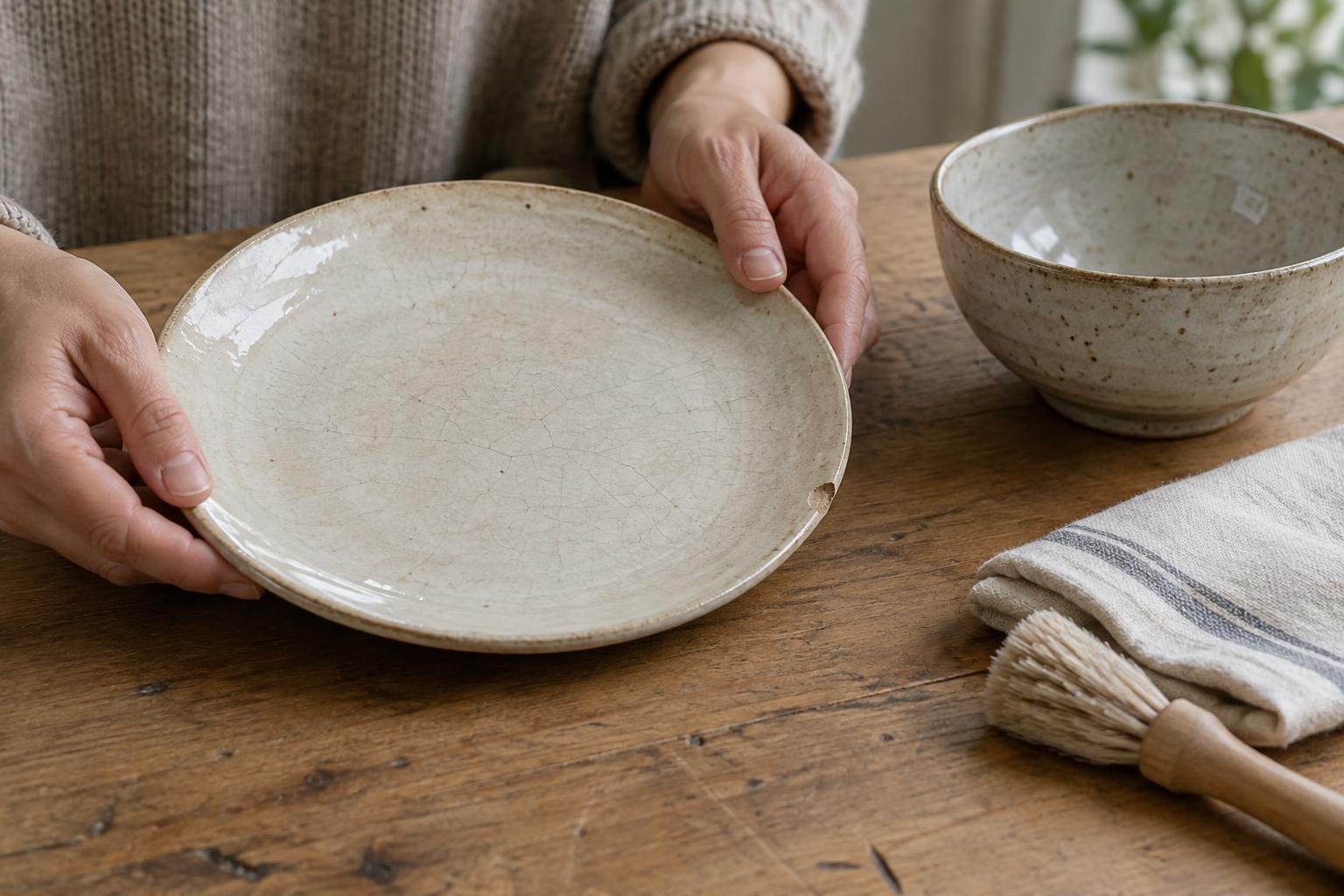
Handmade tableware often shows variations in shape, glaze and surface texture. A mark is not necessarily damage. Before changing how you use a piece, examine it in good light, then run a fingertip gently over the area. Do not drag your finger across a sharp edge. Look at both sides, especially around rims, handles and the base.
A chip is a missing fragment of ceramic or glaze. It may leave a rough, sharp edge or expose the clay beneath. A crack is a break that can run through the body of the piece; it may be easier to see on one side than the other. Crazing is a network of fine lines in the glaze, rather than an obvious break in the underlying ceramic. The distinctions are useful, but they can be difficult to make by sight alone. If you cannot tell whether a line is confined to the glaze, treat the piece cautiously.
Decide whether it still belongs at the table
Set aside a plate, bowl or mug with a sharp chip where hands or mouths might touch it. Stop using a piece for food or drink if it has a crack, leaks, feels unstable or has a damaged handle. A crack can widen during ordinary handling, and a broken handle can fail while a vessel is full. A chipped area on a food-contact surface may also be difficult to clean thoroughly.
Crazing calls for a more measured decision. Fine glaze lines do not always mean that the ceramic body is cracked, but they can collect stains or residue, particularly if the surface no longer cleans easily. If a crazed piece develops persistent discoloration, an odor, seepage or a new visible crack, retire it from food service. With older or unidentified ware, its original food suitability may be uncertain even when it looks intact; appearance alone cannot establish the composition or condition of its glaze.
Retirement from food use need not mean disposal. A sound piece can hold keys or other dry objects, provided its edges are not sharp and its condition suits the task. Avoid using a damaged vessel to hold water unless you are prepared for possible leakage. If the piece has personal value, a ceramic conservator or experienced restorer may be able to discuss options without promising that a repair will make it suitable for meals.
Clean gently and avoid sudden temperature changes
Unless the maker has provided different care instructions, wash handmade ceramics by hand with mild dish soap, warm water and a soft cloth or sponge. Rinse and dry them promptly, paying attention to the foot ring, where unglazed clay may remain damp. Avoid abrasive pads that can scratch a glaze or catch on a damaged edge. Do not soak a chipped or cracked piece in an effort to remove a stain.
Temperature changes are another reason for caution. Moving a cold vessel straight into very hot water, or setting a hot dish on a cold, wet surface, can put stress on ceramic. Do not assume a handmade piece is safe for the oven, microwave or dishwasher simply because similar-looking ware is. Follow any guidance supplied by its maker, and be especially conservative with damaged or unidentified pieces.
If staining persists in crazing, repeated hard scrubbing is unlikely to solve the underlying issue and may make the surface harder to care for. Clean the piece gently, let it dry fully and reconsider whether it is appropriate for food use.
Approach repairs as preservation, not a food-safety fix
A cleanly broken ceramic object can sometimes be reassembled for display. First collect and store any loose fragments so their edges do not rub against other pieces. Avoid trying to smooth a chipped rim yourself: removing material can enlarge the damage or create dust and a less stable edge.
A household adhesive may hold fragments together without restoring the strength of the original ceramic. It may also leave seams that are difficult to clean. Even when a product is described as suitable for some food-contact applications, that does not establish that a particular repaired cup or plate is appropriate for repeated food use, heat or washing. Keep repaired pieces out of food service unless you have reliable guidance specific to the material, repair and intended use.
For everyday prevention, give each piece enough space in the cupboard that rims and handles do not knock together. When stacking plates or bowls, a soft separator can reduce rubbing, but avoid building a stack that presses heavily on delicate edges. A brief inspection while washing or putting pieces away makes it easier to notice a new chip or spreading line before the next meal.