Look closely before you clean
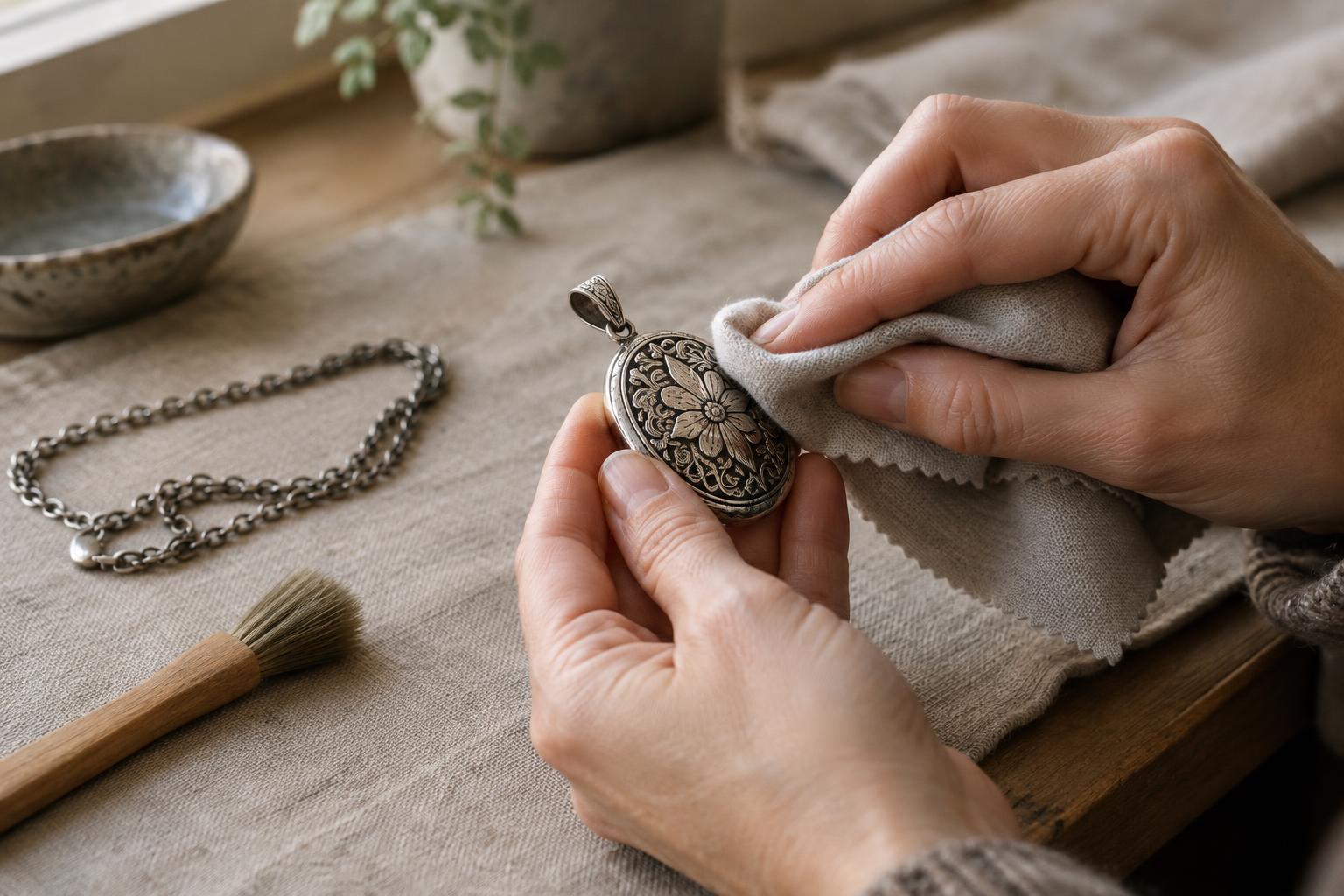
Silver tarnish is a surface change that often appears yellow, brown or dark grey. It can make a smooth surface look dull, but darkness in the recesses of jewellery is not always a problem. A maker may have deliberately darkened engraved lines, stamped patterns or the spaces behind raised details to give them contrast. Removing that finish can flatten the appearance of the piece even if the metal becomes brighter.
Begin by examining the jewellery in good light. Note any stones, pearls, enamel, glued components, textured surfaces or very fine chains. Check whether settings feel secure and whether the surface shows a different colour at worn edges; that may indicate silver plating over another metal. A hallmark can offer a clue about composition, but it does not tell you whether every attached element can tolerate the same cleaning method. If a piece is fragile, valuable to you or difficult to identify, a specialist jeweller is the safer choice.
Start with the least aggressive method
For jewellery that appears sturdy, begin with a clean, dry, soft cloth. Gently wipe the surfaces that touch skin to remove oils and loose dirt. Do not pull a chain through the cloth with force: fine links can catch and stretch. A soft, dry brush can lift dust from an open design, provided its bristles do not snag prongs or fibres. Sometimes removing surface grime is enough to improve the appearance without tackling every dark patch.
If the piece is plain, solid silver with secure construction and no water-sensitive additions, you can use lukewarm water with a small amount of mild soap. Wipe or briefly wash it with a soft cloth, paying attention to areas where residue collects. Rinse away the soap and dry it promptly and thoroughly with a clean cloth. Moisture left in a hollow section, clasp or tight setting can be difficult to remove, so avoid soaking pieces with such features. If you are unsure how an element is attached, skip the water and keep the cleaning dry.
Polish selectively, not everywhere
A silver-polishing cloth can remove tarnish from accessible metal, but it also removes a small amount of surface material as it works. Use light pressure on broad, raised areas rather than scrubbing across the entire piece. Fold a clean part of the cloth over a fingertip to control where it touches. Stop when the surface looks cared for; there is no need to chase every trace of darkness from an intricate design.
Keep the cloth away from soft or porous stones, pearls, enamel and deliberately darkened recesses. Be especially restrained with silver-plated jewellery: repeated polishing can wear through its thin silver layer, particularly along edges and high points. A heavily textured or antique-looking piece may be better left with some patina than polished to a uniform shine. If the cloth catches on a setting, stop rather than trying to work around it with greater pressure.
Avoid shortcuts that can strip or scratch
Toothpaste and other gritty household pastes can scratch silver and abrade plating. Tarnish-removing dips may act in places you cannot see or control, including recesses meant to stay dark. Methods that use aluminium foil and a cleaning solution can likewise change the appearance of a whole piece rather than just its dull outer surfaces. None is a good first choice for jewellery with stones, mixed materials or intentionally contrasting details.
Ultrasonic cleaners are not a universal shortcut either. Their vibration and the cleaning solution used with them may be unsuitable for certain stones, treatments, adhesives or weakened settings. Do not assume that a method is safe for an entire piece simply because it is described as safe for silver. When jewellery combines materials, the most vulnerable component determines how cautiously you should clean it.
Keep the finish you have cared for
Once the jewellery is dry, store pieces separately so chains do not tangle and hard settings do not rub against softer surfaces. A closed pouch or box can limit exposure to air and moisture; keeping the storage space dry also helps. Wipe jewellery gently after wearing it to remove skin oils and other residues before they build up around details. These small habits can reduce how often a piece needs more involved cleaning.
If tarnish returns quickly, a setting moves or dark residue continues to transfer after gentle cleaning, pause and have the piece assessed. The goal is not to make every surface look new. It is to preserve the construction, contrast and character of the jewellery while removing only the dullness you can address safely.