Understand what you are measuring
Ring size describes the space inside a ring, but sizing labels vary by country. Some systems use numbers, others use letters, and a label alone does not tell you how a particular ring will feel. When comparing measurements, check which sizing system a maker uses. An inside diameter is a straight-line measurement across the opening; an inside circumference is the distance around it. Do not treat the two as interchangeable.
A good fit balances two needs: the ring must move over the knuckle, then stay reasonably secure at the base of the finger. It may take a little effort to remove, but it should not pinch or leave the finger feeling compressed. If your knuckle is noticeably wider than the base of your finger, this balance can be especially difficult. Measure the finger on which you intend to wear the ring, since the same finger on the other hand may fit differently.
Measure with an existing ring or a finger
If you own a ring that fits the intended finger well, measure its inside diameter with a precise ruler or calipers. Look straight down at the opening and measure from one inner edge to the opposite inner edge, without including the metal. Repeat the measurement and compare the result with the seller’s size chart. This works best when the reference ring has a similar width and interior shape to the one you plan to choose.
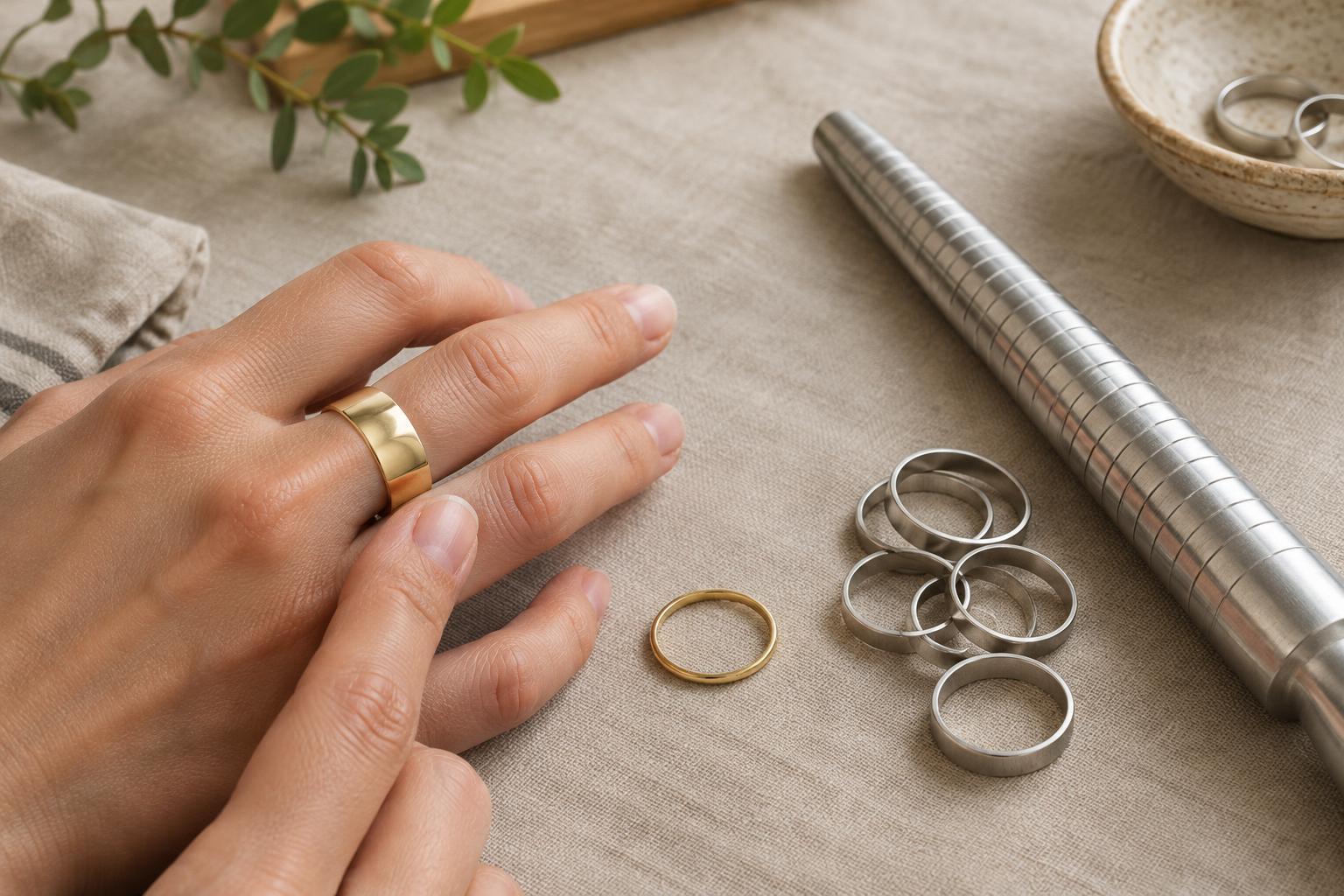
To measure the finger directly, a reusable ring sizer or a set of sizing rings gives you a chance to test how a ring passes over the knuckle. Try the size on, move your hand naturally, and take it off again before deciding. A strip of paper or non-stretch string can provide an approximate circumference: wrap it snugly without pulling it tight, mark where the ends meet, and measure the length. Paper can twist and string can dig into the skin, so use this as a starting point rather than a final answer for an expensive or hard-to-resize ring.
Finger size can change through the day and with temperature or activity. Try a sizer more than once under ordinary conditions rather than relying on a reading taken when your hands are unusually cold or swollen. If two measurements disagree, investigate the difference instead of automatically choosing the larger one.
Why band width changes the fit
A broad band covers more of the finger than a narrow one. Even when two rings have the same marked size, the wider ring may feel snugger because it contacts a larger area and can be harder to slide over the knuckle. The difference is easier to notice when you move from a very slim ring to a substantial band. A narrow reference ring is therefore not a reliable final test for a much wider design.
There is no universal size increase that suits every wide ring. Width, finger shape and interior construction all affect the result. If possible, try a sample ring close to the intended band’s width. Check it while your fingers are relaxed, then make a fist and open your hand. A ring that feels acceptable for a moment may become uncomfortable when you wear it for longer.
Look at the inside of the band
Width is only part of the fit. A band with a flatter interior can have a different feel from one with a rounded interior, often called a comfort fit. Rounded edges may make a broad ring easier to move over the knuckle, but the label “comfort fit” does not guarantee a particular size. A thick band can also feel different from a thin one with the same opening.
When ordering from a maker, describe the ring you used as a reference: its approximate width, whether its inside is flat or rounded, and how it fits over your knuckle. Ask how the intended ring is sized and whether a physical sample or sizing kit is available. Those details are more useful than a size label on its own.
Check your choice before committing
Test the proposed size with the activities that reveal a poor fit: letting your hand hang at your side, gently shaking it, making a fist and removing the ring. It should not slip off unexpectedly, rotate so freely that its position bothers you, or require force to take off. If you plan to wear two rings together, try them together if you can; a stack can feel broader than either ring alone.
Finally, find out whether the finished design can be resized. A plain band may allow more adjustment than a ring with stones or a pattern running all the way around, but possibilities depend on its construction and material. When resizing options are limited, taking time to test a band of similar width and shape is particularly worthwhile.