Why the direction of movement matters
A jump ring is a loop of wire with two ends that meet at a seam. In jewellery, it often connects a clasp, charm or chain. The simplest way to open one may seem to be pulling the ends away from each other, making the loop wider. That movement distorts the circle, however, and can leave a gap that is difficult to close neatly. Forcing the ring back into shape adds more bending at the seam.
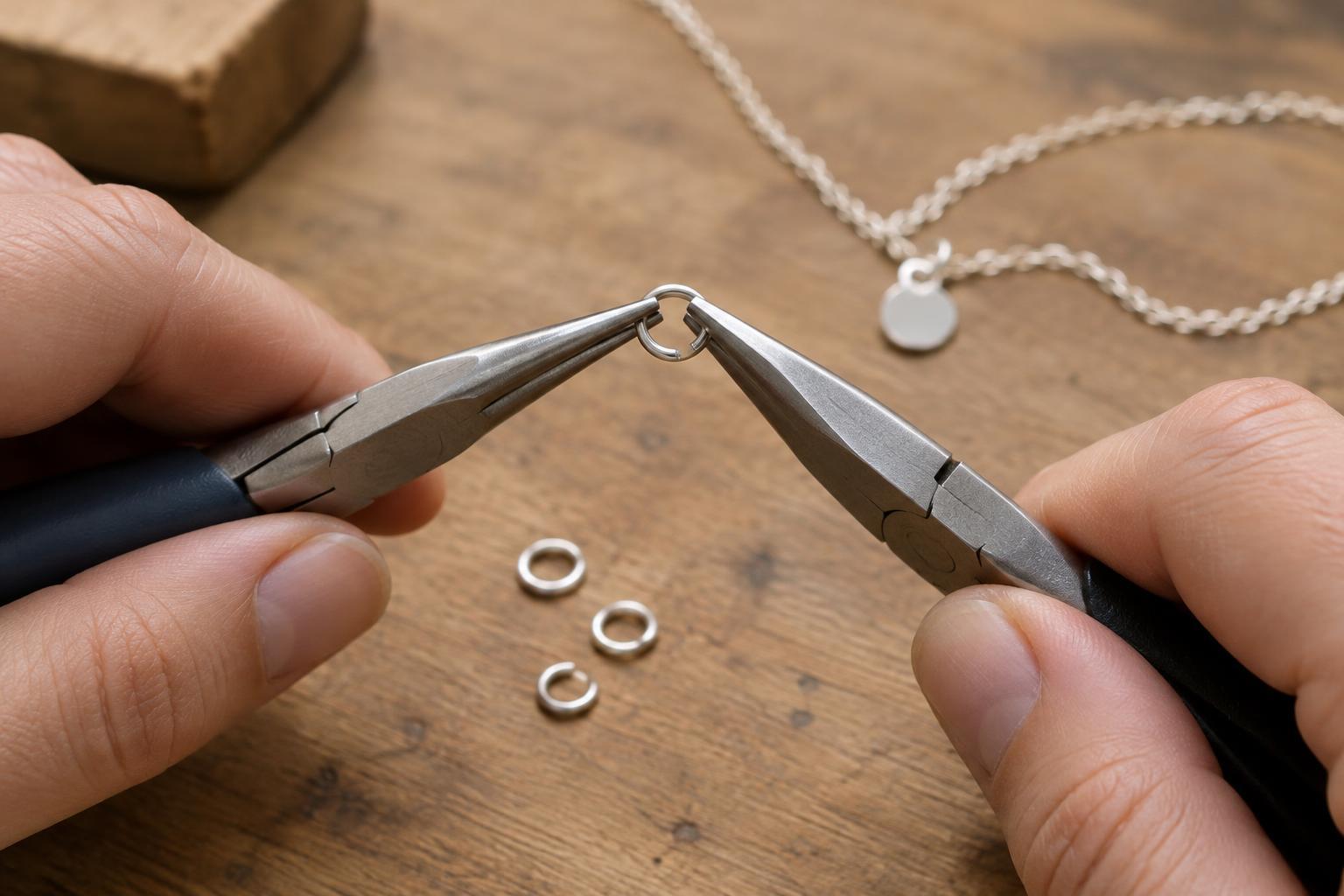
Instead, move the ends sideways past one another, as though opening a small gate. Most of the ring keeps its round shape, and the opening only needs to be wide enough for the component to pass through. The aim is not to make the ring perfectly rigid; it is to avoid unnecessary bending and repeated adjustments that can weaken or deform the wire.
Choose a ring and tools suited to the task
First, check that you have an open jump ring rather than a soldered ring or a split ring. An open jump ring has a visible seam and is designed to be opened with tools. A soldered ring has a joined seam and should not be forced apart. A split ring winds around itself like a tiny key ring and is fitted differently.
Use two pairs of pliers with smooth, clean jaws. Flat-nose or chain-nose pliers give a controlled grip close to the seam without the tooth marks that serrated jaws can leave. Jewellery pliers are helpful because their jaws fit small rings, but the important features are a secure grip and edges that will not gouge the surface. On easily marked metal, use a light touch; protective jaw covers may help, provided they still let you hold the ring firmly.
Select a ring that fits the parts it must connect without being so large that they slide freely towards the seam. Wire thickness matters too: a thin ring may be easy to open but unsuitable for a heavy charm or a connection that is frequently pulled. If a join must carry significant weight or secure a valuable piece, consider a more secure construction rather than relying on an ordinary unsoldered ring.
Open the ring with a sideways twist
Hold the ring upright so that you can see the seam at the top. Grip one side near the seam with each pair of pliers, leaving the cut ends visible. Keep your hands close enough for control without pinching the ends themselves.
Hold one side steady. Move the other side gently towards you or away from you, so the ends pass sideways rather than separating across the diameter of the circle. Open the gap only as far as needed to slide on the clasp, chain link or decorative component. A wide opening demands more work to close and makes it easier to lose the ring’s shape. If a component will not pass through a modest gap, check whether a different ring size is the better choice.
Close the seam and inspect it
After adding the component, grip both sides near the seam again. Reverse the sideways motion until the ends meet. Look at the ring from the front and from the edge: the ends should be aligned, without one sitting noticeably in front of the other. They should meet closely rather than leave a gap through which a fine chain link could escape.
Some rings spring back slightly when you release the pliers. If that happens, make one small, controlled adjustment and check again. Avoid repeatedly rocking the ends back and forth in search of a perfect-looking join. If the seam will not sit closed, the wire may be misshapen, the cut ends may be uneven, or the ring may have been worked too much. Replacing it is often more reliable than continuing to bend it.
Know when not to reuse a jump ring
Before putting the piece back into use, check for a visible gap, a flattened section where the pliers gripped, or a change from round to oval that was not part of the design. Feel the seam carefully: an end that catches on fabric may also catch on a fine link. Inspect the connected components to make sure they sit inside the ring rather than pressing against its opening.
A ring that has been opened and closed many times, shows a crack, or no longer holds its shape is a candidate for replacement. This is especially sensible with very fine wire or plated rings, whose finish can be damaged by repeated tool contact. Keeping a few suitable replacement rings on hand makes it easier to choose a sound join instead of asking a tired one to do the job.