What a weaving draft describes
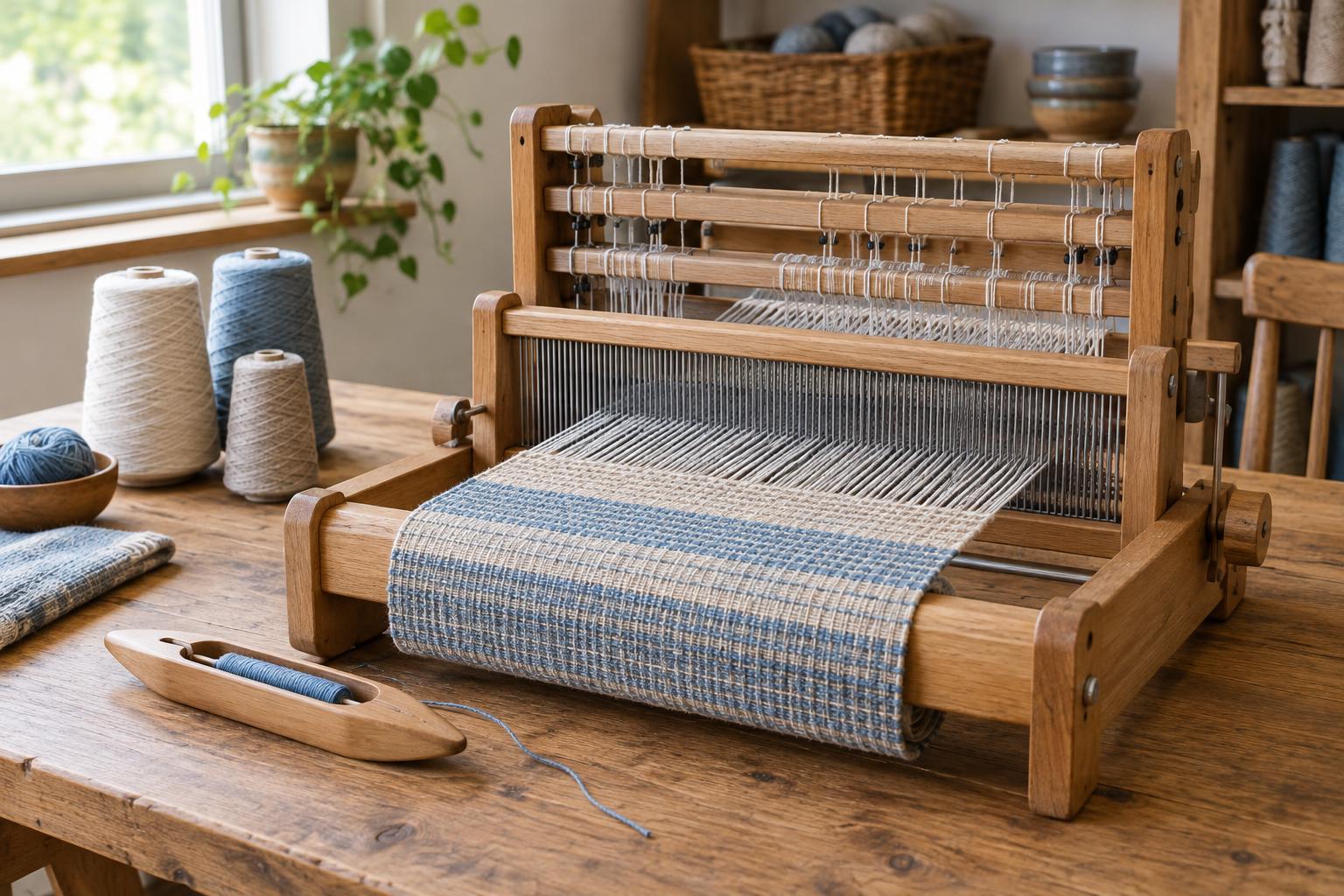
A weaving draft is a set of instructions for how warp and weft cross. The warp threads run lengthwise through the loom; the weft passes across them. On a shaft loom, each warp thread passes through a heddle on one shaft. Moving selected shafts creates a gap, or shed, for the weft. The draft tells you which shaft holds each warp thread, which shafts move together and the order in which to make sheds.
Most drafts use small grids rather than written directions. Their placement on the page can vary, so look for labels instead of assuming that a particular grid is always at the top or side. You may also see a drawdown: a preview of the cloth formed when the threading, tie-up and treadling are combined. A draft describes the interlacement, but it does not by itself specify yarn thickness, sett, beat or finishing. Those choices affect how the woven cloth looks and feels.
Threading: where each warp end goes
The threading grid assigns each warp end to a shaft. Each column represents one warp thread, also called an end. A mark in that column identifies the shaft whose heddle receives it. Read the columns in the direction indicated by the draft or its written instructions; drafts do not all use the same left-to-right convention. Shaft numbers may also be counted from the front or the back of the loom, so check the numbering used in the draft against your loom.
For a straightforward four-shaft example, imagine a threading that repeats 1, 2, 3, 4. The first end goes through a heddle on shaft 1, the second through shaft 2, and so on before the sequence starts again. Repetition marks or a bracket may show that the sequence continues across the warp. Threading is not the same as sleying: putting ends through the reed is a separate step, usually specified elsewhere in the project instructions.
Before threading a long warp, follow a short section of the grid with your finger and say the shaft numbers aloud. This helps you identify where a repeat starts and ends. If a draft includes borders or a different sequence at the edges, do not assume every column follows the central repeat.
Tie-up: which shafts move together
The tie-up connects treadles to shafts. In a simple draft, one direction of the tie-up grid lists shafts and the other lists treadles; the marks show which shafts a treadle operates. What “operates” means depends on the loom. On a rising-shed loom, the marked shafts may lift. Other loom mechanisms can lower shafts or require a different tie-up to produce the intended shed. Read any loom-specific notes before copying the grid directly.
For the four-shaft threading above, suppose treadle A lifts shafts 1 and 3, while treadle B lifts shafts 2 and 4. Pressing A raises every other warp end in the repeated threading; pressing B raises the ends between them. This is one way to set up plain weave on a suitable rising-shed loom. It is not the only possible tie-up: changing which treadle is connected to which shafts can still make the same two sheds. Label your treadles if their physical order differs from the order shown on the page.
Treadling and drawdown: following the sequence
The treadling grid gives the order of treadle presses. Each row represents a weft pick, or one pass of weft through the shed. In the example, an alternating A, B, A, B sequence makes successive picks pass over and under opposite groups of warp ends. Check the draft’s reading direction before starting: the first pick may appear at the top or the bottom of the grid. A numbered sequence, if supplied, removes that ambiguity.
The drawdown lets you check the combined effect. Each small square corresponds to a crossing of one warp end and one weft pick. A filled square commonly indicates that the warp is visible on top, but shading conventions vary. With the example’s rising-shed tie-up, an A pick places the warp ends on shafts 1 and 3 above the weft; the next B pick places those on shafts 2 and 4 above it. The resulting over-under alternation is plain weave.
To check your reading, trace just two neighboring warp ends and two consecutive picks through all three grids. Ask which shaft holds each end, which shafts the chosen treadle moves and which thread will sit on top at each crossing. Then weave a short sample. If its interlacement differs from the drawdown, revisit the draft’s reading direction, shaft numbering and loom mechanism before changing the yarn or beat.