What skiving does
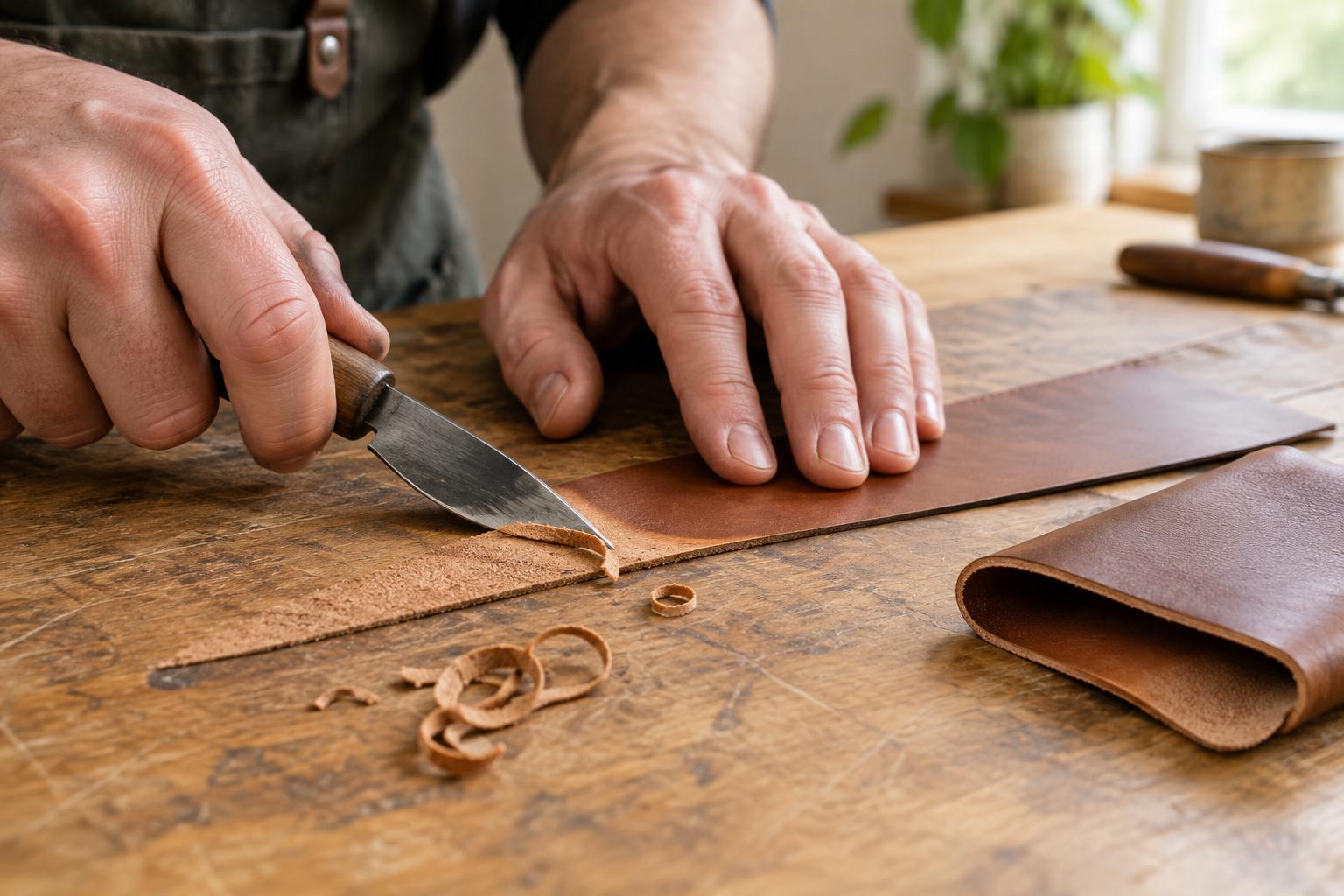
Skiving means shaving leather to reduce its thickness in a chosen area. It is useful where an edge will be folded over, two pieces will overlap, or several layers will meet at a seam. Without thinning, those areas can form a stiff ridge even when the rest of the object feels supple. A gradual taper usually blends into the full-thickness leather more smoothly than an abrupt step.
For many folded edges, the goal is to thin the flesh side, leaving the finished grain surface intact. A join may call for a different shape: two overlapping ends can each be tapered so their combined thickness stays closer to that of one piece. The aim is not to make every part as thin as possible. Leather still needs enough substance to hold its shape and withstand handling, stitching or fastening.
Choose a tool and prepare the work
A sharp skiving knife gives direct control over the width and depth of a cut. Some makers use a replaceable-blade skiver for narrow edges. Either tool can work, but its blade needs to cut cleanly; a dull edge is more likely to drag, catch or encourage excessive pressure. Learn the cutting direction of the particular tool before using it on a project piece.
Work on a firm, stable surface that will not shift beneath the leather. Mark the area to be thinned on the flesh side, allowing for the full width of a fold or overlap. Keep fingers clear of the blade’s path and arrange the work so a slip will not carry the tool toward your hand or body. If the piece is small, reposition or hold it securely rather than trying to control it with fingertips close to the cut.
Before starting on the object, try the tool on an offcut of similar leather. Leather varies in firmness, stretch and thickness, so a cut that behaves well on one piece may dig into another. An offcut also gives you a place to test the width of the skive and the feel of the resulting fold.
Make a gradual taper
Set the blade at a shallow angle to the flesh side and remove a thin shaving. Begin where the taper should meet the full-thickness leather, then work toward the edge or end that needs the most reduction. Use controlled passes rather than trying to take off all the material at once. A broad, even skive is easier to judge when the blade is not being forced through a thick layer.
Pause often to feel the leather between your fingers and look across the skived surface. High spots can be reduced with another light pass. If the blade catches or leaves a gouge, stop and adjust your angle or check the blade rather than cutting harder. Leave some thickness at the thinnest point; a nearly transparent edge may fold easily but can also become fragile.
For a folded edge, test the fold in its intended direction before removing more material. For an overlapping join, place the pieces together to check the combined thickness. These simple checks are more useful than aiming for a particular measurement without considering how the leather will be assembled.
Check the fold or join before fixing it
A good skive makes the transition less noticeable without creating a weak line where thin leather meets thick. Fold the edge gently and look for a smooth curve rather than a sharp hinge. At a lap join, check that the overlap lies flat and that its ends do not form raised steps. If stitching will pass through the area, make sure the leather along the stitch line remains substantial enough for the intended construction.
Skiving cannot correct every bulky assembly. A fold may still be thick because several layers meet in one place, or a join may sit unevenly because its pieces are misaligned. Changing the order of assembly, trimming an allowance or spreading layers across a wider area may help more than further thinning. Once leather has been shaved away, it cannot be put back, so make adjustments in small stages.
After skiving, finish the fold or join using an adhesive or fastening method suitable for the leather and the object. Pressing the pieces together can reveal bumps missed during cutting. If an area feels unusually soft, stretches readily or shows a cut into the grain side, reconsider using that piece in a part that will take strain.
Common mistakes to avoid
The most common difficulty is removing too much at once. Deep cuts can leave ridges, holes or a thin strip that tears when folded. Another is thinning only a narrow line when a broader transition is needed; the result may behave like a hinge instead of a smooth fold. Marking the intended area and testing it during the work helps keep the taper purposeful.
Do not assume that a skived edge must be perfectly uniform to the eye. The useful test is whether it folds or joins neatly while retaining enough strength for its role. With a sharp tool, a steady surface and a willingness to stop and check, hand-skiving becomes a controlled way to manage bulk rather than a race to remove material.