Start beneath the surface
A smooth finish or convincing grain pattern does not tell the whole story of a wallet, bag or key case. Leather, bonded leather and synthetic leather may all have a coloured surface and a soft backing, yet the material supporting that surface is different. Looking at the layers helps explain why two similar-looking accessories can wear and respond to repair differently.
These names describe broad material families, not fixed grades of workmanship. Thickness, finishing, stitching and the way an accessory is used all matter. A well-constructed item also needs sound seams, suitable hardware and edges that can withstand handling. Material is a useful starting point, but it is not a complete verdict on quality.
Leather: a piece of hide with its fibre structure intact
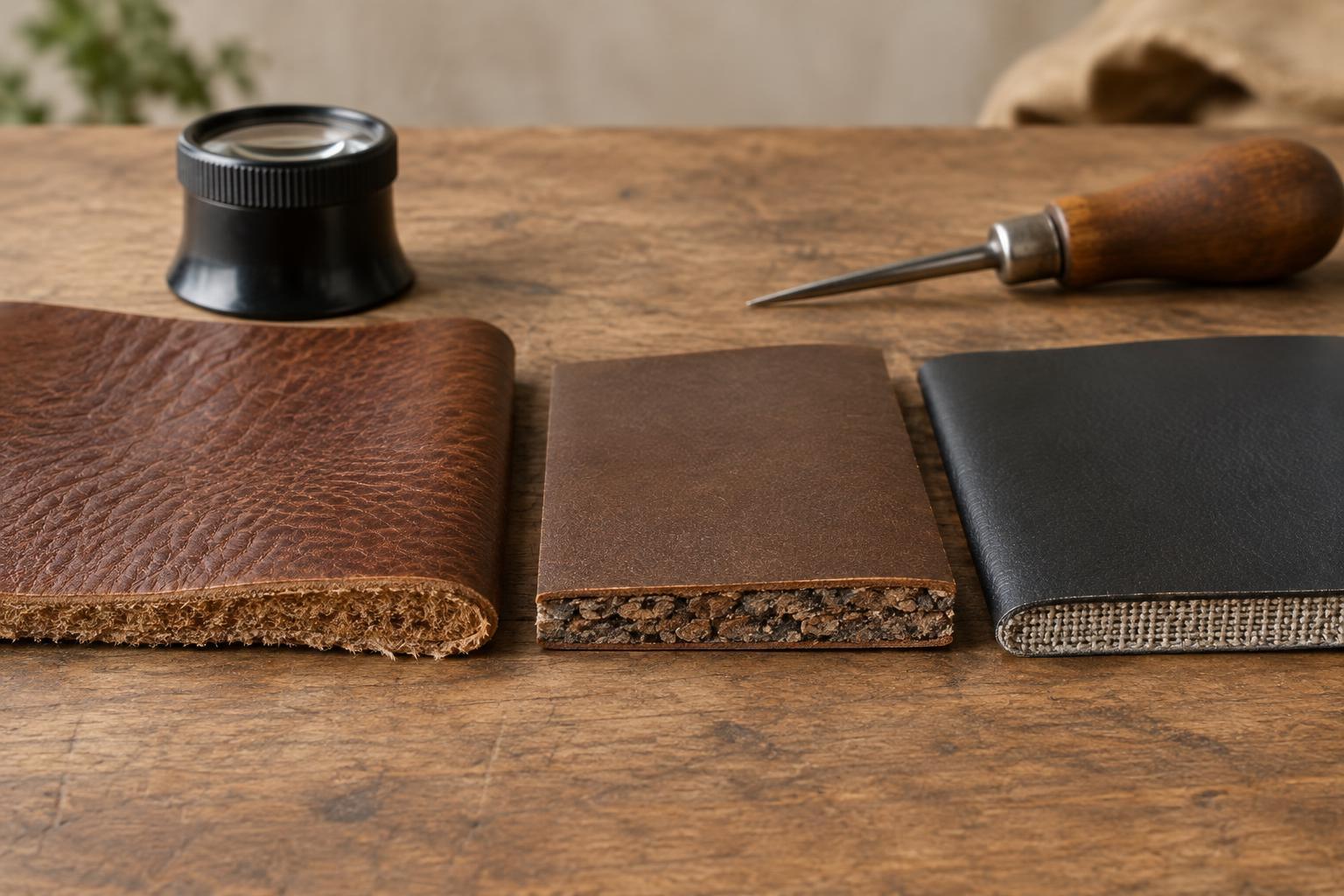
Leather is made from animal hide that has been tanned to make it usable as a durable material. In a leather panel, the fibres belong to the hide itself rather than to a fabric base. A maker may use the outer portion, including its natural grain, or a lower layer known as a split. The split can be finished or coated to create a smooth or textured face, so an even-looking surface does not necessarily reveal which layer was used.
The visible side may be dyed, embossed or covered with a finish. Those treatments can change how much natural variation you see and how the surface feels. On an unfinished cut edge, leather may show a relatively continuous, fibrous cross-section. Many accessories have painted or folded edges, however, which hide that detail. A label can be helpful, but a close look at accessible edges and the reverse side often provides more context.
Bonded leather: leather fibres held together with binders
Bonded leather is made by combining leather fibres or scraps with binding materials to form a sheet, often with a surface coating or embossed pattern. Its structure is therefore unlike a continuous piece of hide: the fibres have been separated and reassembled. The proportions, backing and finishes can vary, so the term alone does not tell you exactly how a particular item will perform.
Bonded leather can present a tidy, uniform face, which makes it difficult to identify by appearance alone. At a damaged edge, you might see a distinct coating above a more composite-looking layer. Avoid peeling an intact surface just to investigate it. If the face coating begins to lift or flake, ordinary leather conditioner will not join it back to the layer below. A patch or replacement panel may be more realistic than a surface treatment, depending on how the item is made.
Synthetic leather: a manufactured surface on a base
Synthetic leather is made without an animal-hide layer. Many versions use a polymer surface, commonly polyurethane or polyvinyl chloride, applied to a textile or other backing. Others use fine synthetic fibres arranged to give a different hand feel. These constructions can be made in a wide range of colours, textures and thicknesses; the words “synthetic leather” do not identify one single recipe.
A cut edge or exposed underside may reveal a fabric-like base beneath the face layer. In a finished accessory, that base can be concealed by lining, edge paint or folded seams. Some synthetic surfaces bend readily, while others feel stiffer; neither impression proves what they are made from. Likewise, “vegan leather” indicates an animal-free intention rather than a specific construction. If the precise material matters to you, look for a more detailed description from the seller or maker.
How to inspect and care for an accessory
Examine an unobtrusive edge, seam allowance or unlined interior if one is available. Look for a continuous fibrous layer, a composite layer beneath a coating, or a textile backing. Then check the workmanship: are seams secure, are high-friction corners protected, and does the edge finish appear sound? No single clue is conclusive, especially when an item is heavily coated or lined. If you cannot see the construction clearly, it is reasonable to leave the material unidentified rather than guess.
For routine care, start with a soft, dry cloth and follow any care guidance supplied with the item. Test a suitable cleaner on a hidden area before using it more widely, and avoid soaking seams or using harsh solvents. Leather care products are not automatically appropriate for bonded or synthetic surfaces; even on leather, a coated finish may limit what a conditioner can reach. Keeping small accessories away from prolonged dampness, excessive heat and repeated abrasion is a sensible approach across all three material families.
When damage appears, identify what has failed before choosing a remedy. A loose stitch may be repairable regardless of the outer material. A worn finish on leather may call for a different approach from a separating coating on bonded or synthetic material. Understanding the layers helps you ask better questions, choose gentler care and judge whether a repair is likely to hold.