What counts as a lining?
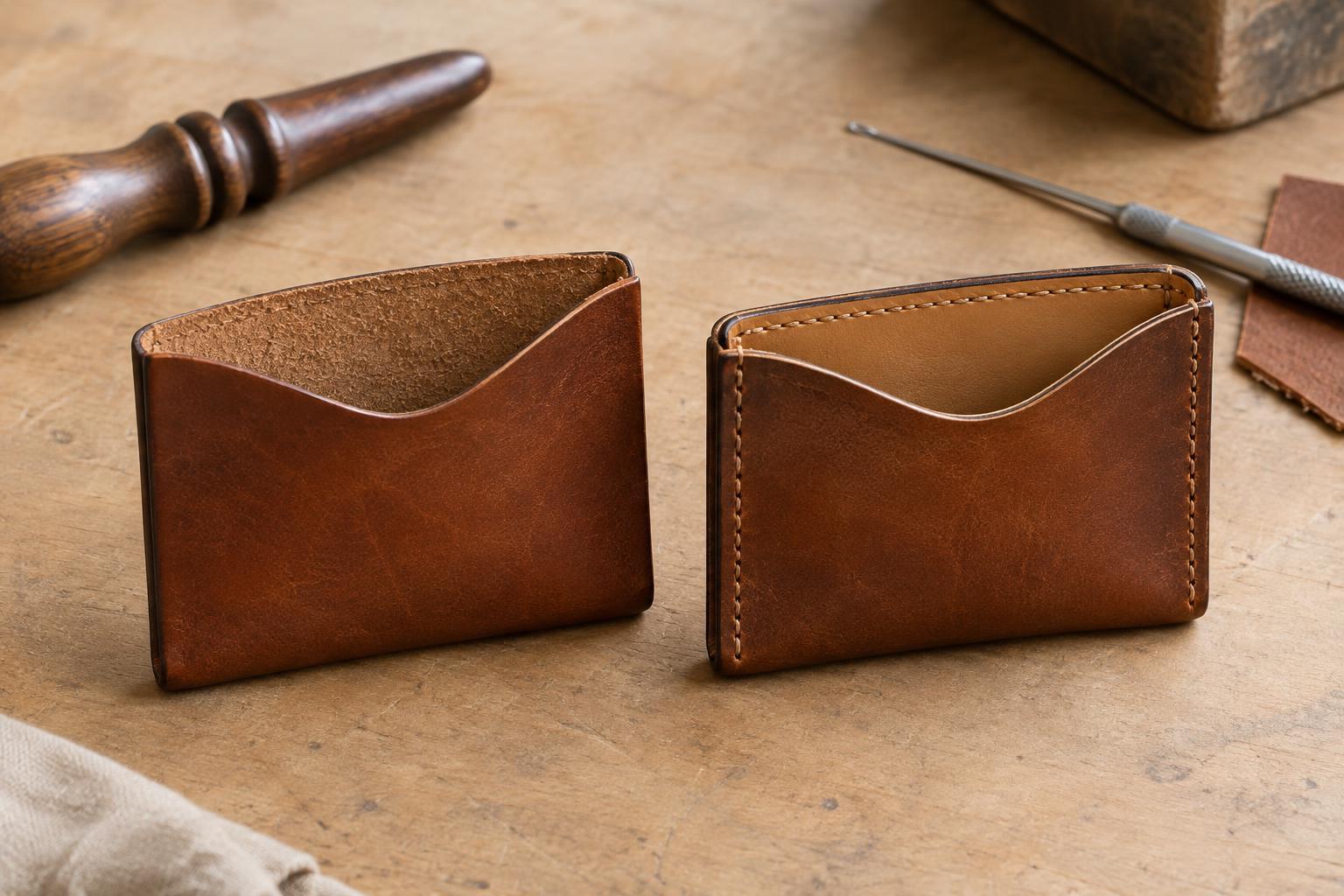
An unlined leather accessory uses the inner face of its main leather as the visible interior. In a simple pouch, for example, the outside may show the smooth grain surface while the inside shows the leather’s flesh side. That interior might be left soft and fibrous, smoothed during finishing, or given a coating. “Unlined” does not mean unfinished.
A lined accessory has another material covering some or all of that interior. The lining might be thin leather, textile or another suitable sheet material. It can form a complete inner compartment, cover a single panel or appear only in selected pockets. When comparing accessories, look at which parts are actually lined rather than relying on a label alone. A wallet with a lined main compartment may still have unlined card slots.
How lining changes the way an accessory is assembled
In an unlined design, the maker can often cut the outer panels, prepare their edges, then join the panels directly. Stitching may pass through two or more leather layers, depending on the shape. Because the inside remains visible, the backs of the panels, seam allowances and any interior stitch lines need to suit the intended finish.
Adding a lining introduces another layer that must be cut, positioned and secured. It may be attached with stitching, adhesive, or a combination of the two. Some linings are joined to each outer panel before the accessory is assembled; others are made as a separate interior and fitted into an outer shell. Those choices affect where seams appear and whether the lining can lie flat when the accessory bends.
Extra layers can add bulk at folds, corners and openings. A maker may reduce the thickness of leather near an edge—a process called skiving—or choose a particularly thin lining to keep those areas manageable. Careful sizing matters too: a lining cut too tightly may pull against the outer leather, while excess material can wrinkle inside. Neither lined nor unlined construction is inherently more skilled; each calls for decisions suited to the design.
Edges, openings and pockets reveal the difference
The edge is often the clearest place to see how a lining is integrated. On an unlined card holder, a cut edge may expose the full thickness of the leather. It might be rounded and burnished, painted, or left with a deliberately simple finish. If multiple panels are stacked, their edges may be finished together.
A lined piece can have both materials captured in a stitched edge, or its outer leather may be folded over the lining at an opening. Some designs hide raw edges inside a turned seam. Each approach produces a different profile: folded edges tend to look rounded, while stacked, finished edges can show a more defined outline. Look for an even transition where the lining meets the outer material, particularly around curves and at pocket mouths.
Pockets add another construction decision. A thin lining can provide a smoother surface for sliding items in and out, but its attachments need to withstand repeated use. Check that pocket edges feel secure and that corners are not already lifting. In an unlined pocket, the feel and finish of the leather’s inner face matter more because cards, keys or other contents touch it directly.
What changes in feel and everyday use?
Lining can make an interior feel smoother or more visually uniform, and it may cover rougher areas of the main leather. It can also help define the shape of compartments. The trade-off is added material: in a compact wallet, even a thin lining may make a noticeable difference to thickness or flexibility. A soft lining does not necessarily make an accessory soft overall; the outer leather, reinforcements and number of layers also matter.
An unlined design can feel lighter and more direct, especially when the leather is supple and the pattern uses few pieces. Its interior texture is part of the experience. A fibrous flesh side may create more friction against contents than a smooth lining, although the effect depends on how the leather was finished. For either construction, try opening and closing the accessory gently. It should move without the interior bunching, pulling sharply at stitches or obstructing its intended contents.
Choosing and caring for either construction
Choose according to the job rather than treating lining as a quality ranking. For a slim card holder, an unlined interior may keep the design compact. For a pouch whose contents benefit from a smoother surface, a lining may be useful. Inspect the parts that receive the most handling: openings, folds, pocket corners and seams. Even stitching and tidy edges are useful signs to look for, but appearance alone cannot tell you how an accessory will wear.
For routine care, empty pockets before brushing out loose debris with a soft, dry brush or cloth. Avoid soaking either type of accessory. If cleaning is needed, follow any material-specific care information supplied with the item and test a suitable product in an inconspicuous place first. Textile linings, coated interiors and leather linings can respond differently, so do not assume a product intended for the outer leather belongs inside. Let an accessory dry naturally if it becomes damp, and avoid overfilling it: sustained strain can distort folds and stress seams regardless of whether it is lined.