What the wax model does
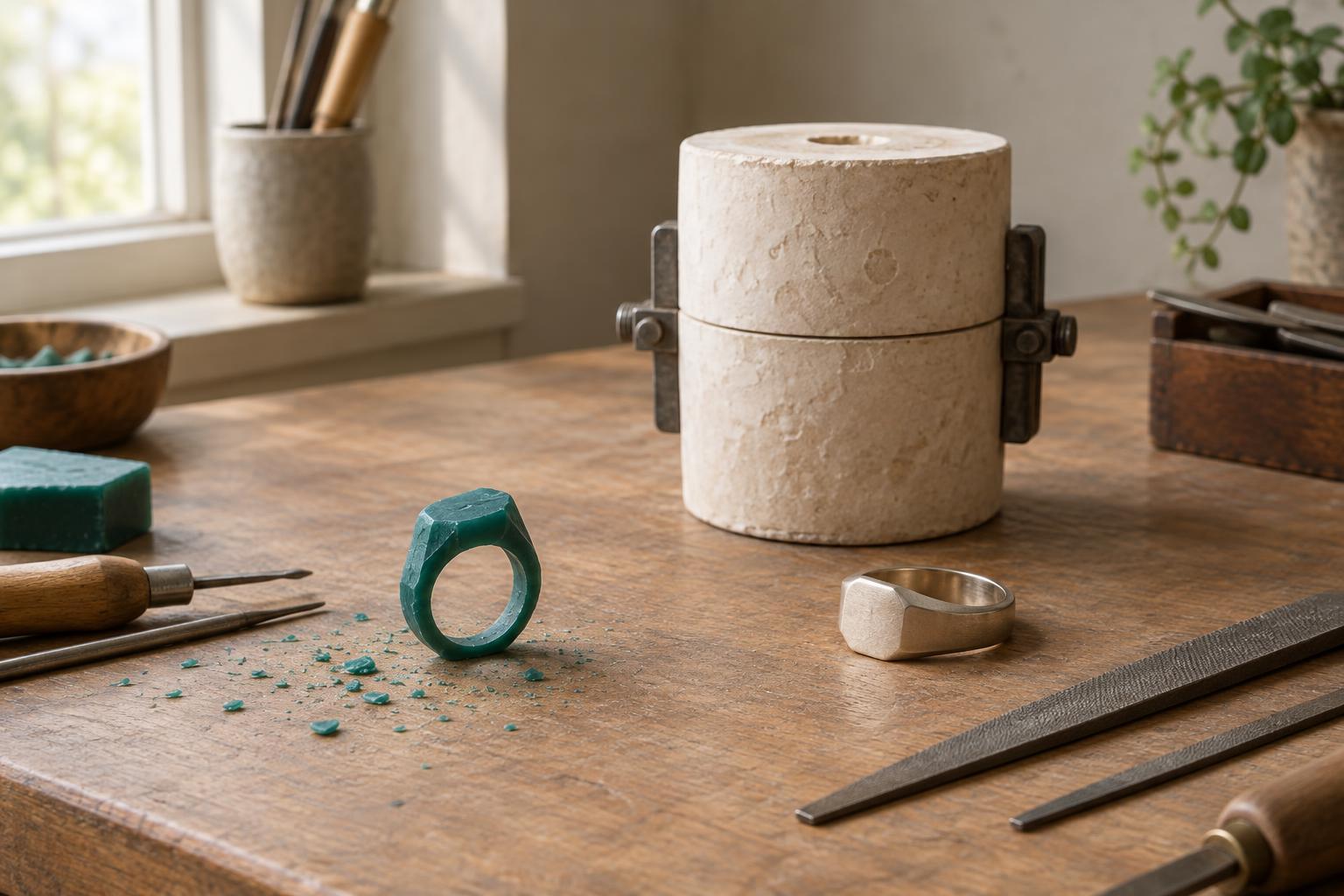
Lost-wax casting begins with a form that will not survive the process: a wax model. A maker may carve the model by hand, build it from wax sheets and wire, or use a wax pattern made from a reusable mould. The model establishes much of the finished piece’s shape, from the curve of a ring to the relief on a pendant. It is not simply a sketch of the intended object; its surfaces and proportions have a direct influence on the metal form.
Designing in wax calls for attention to thickness and transitions. A thin projection may be fragile in wax and difficult to fill with metal, while a sudden change from a heavy area to a delicate one can complicate casting. The maker also needs to consider what will happen after casting. A surface intended for polishing needs to be reachable, and a setting or fitting may need extra material so it can be refined later.
Building a mould around a temporary form
Before the wax is enclosed, a maker attaches one or more wax channels, often called sprues. These connect the model to an opening through which molten metal can enter the mould. Their placement matters: they must provide a useful path for the metal without leaving a connection that will be awkward to remove from a prominent surface.
The model and its channels are then surrounded by a heat-resistant mould material known as investment. Once the investment has set, the mould is heated so the wax leaves and the cavity is prepared for casting. This is the step that gives lost-wax casting its name. The resulting cavity contains the space formerly occupied by the model, including its surface texture and the channels leading to it.
Casting a single wax model destroys that model, but the overall design need not be one of a kind. A reusable mould can produce multiple wax patterns, each of which is invested and cast separately. That distinction is useful when examining jewellery: a cast piece may involve substantial handwork without having been shaped entirely by hand or made only once.
From empty cavity to metal form
Molten metal is introduced through the sprue opening and must travel into the details of the mould cavity. Workshop methods differ, and specialised equipment may help metal reach fine features. The temperatures, fumes and materials involved make melting, burnout and pouring tasks for a properly equipped workspace with appropriate training, rather than casual home experiments.
Successful filling depends on more than the metal itself. The size and position of channels, the shape of the model and the preparation of the mould all affect the result. If metal does not reach a narrow area, a detail can be incomplete. If a casting has unwanted voids or rough patches, the maker may need to assess whether they can be corrected or whether a new model and casting are the better route. These possibilities help explain why a clean finished form can require several decisions before any metal is poured.
Why a casting is not yet finished jewellery
After the metal has cooled, the investment is removed and the sprue is cut away. What emerges is a raw casting, not usually a ready-to-wear piece. The maker may file the former sprue connection, refine edges, correct accessible surface marks and prepare areas that need to join another component. Depending on the design, further work can include soldering, setting stones, adding a clasp or applying a surface treatment.
Finishing changes how the form reads. A polished surface reflects light differently from a brushed or textured one, while crisp edges can define a pattern that looked softer in wax. Finishing should not be confused with erasing every sign of process: some pieces deliberately retain a modelled texture. What matters is whether the surface, edges and functional parts suit the design and feel considered in use.
Reading the finished object
To look closely at a cast piece, start with its overall form, then examine transitions and less visible areas. Do raised details remain clear? Are thin elements proportionate to the rest of the piece? On an object meant to be worn, do edges that meet the skin feel comfortable? A rough spot near a former sprue connection or an unfinished recess may be easier to notice from the back than from the front.
None of these observations can reliably reveal every step taken in a workshop. Cast objects can be hand-finished to different degrees, and a smooth surface alone does not identify the method used to make it. Understanding the route from wax model to metal form is most useful as a way to ask better questions: how was the shape planned, which details were preserved in casting, and where did finishing make the object both usable and visually complete?