A finish changes how metal meets the light
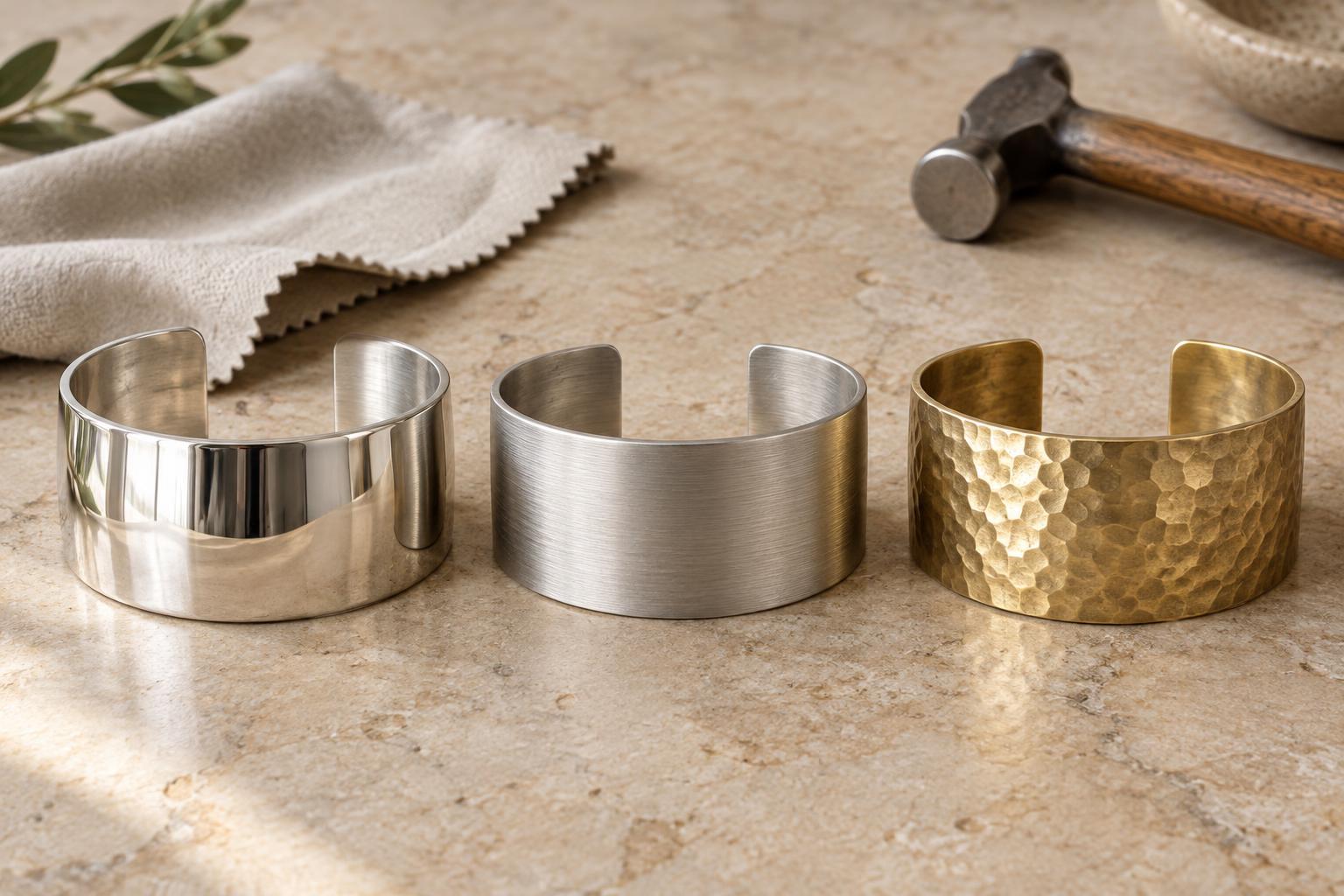
Two pieces made from the same metal can look remarkably different because of their surfaces. A polished pendant reflects its surroundings sharply; a brushed one gives a softer, directional glow; a hammered one breaks reflections into many small highlights. These effects come from the shape of the metal at the surface, not necessarily from a different alloy.
Finish is often one of the last decisions in making a piece, but it is not separate from construction. Curves, edges, joints and recessed areas affect where a tool can reach and how a texture appears. Makers may also combine finishes to draw attention to a rim, raised motif or inset detail. Understanding the marks left by each process helps you look more closely without assuming that a particular finish proves how, where or by whom an object was made.
Polished: smoothing toward a clear reflection
Polishing reduces visible scratches and irregularities until the surface reflects light more evenly. The work commonly begins before the final shine: shaping and filing marks are refined with progressively finer abrasives, then a polishing compound and suitable tool bring up the gloss. Skipping a stage can leave deeper lines visible beneath an otherwise bright surface. Recesses and tight corners may retain a different sheen simply because they are harder to reach.
A polished finish makes contours easy to see, but it can also show fingerprints and new scratches readily. A mirror-like face may reveal slight waviness when it reflects a straight line; that observation says something about the surface, not automatically about the quality of the whole piece. Polishing can remove a small amount of metal, so repeated aggressive polishing may soften crisp edges, engraved marks or other fine details over time.
Brushed: fine lines with a deliberate direction
A brushed finish is made by passing an abrasive across the metal in a controlled way. Depending on the tool and the size of its abrasive particles, the resulting lines can be fine and subdued or more pronounced. On a flat surface, consistent strokes tend to create a uniform direction; on a curved surface, the lines may follow the form. The tiny grooves scatter reflections, giving the metal a quieter appearance than a high polish.
Look at a brushed piece from several angles. You may see the sheen shift as the lines turn toward or away from the light. Lines that run in different directions can be an intentional design choice, particularly where separate parts meet. If a shiny scratch crosses the grain, it may stand out even though the surrounding finish looks less reflective. Restoring an even brushed appearance generally means working with the existing direction and a suitable abrasive, rather than rubbing at one spot at random.
Hammered: shaped by repeated impacts
A hammered finish comes from a series of controlled blows that leave shallow impressions or facets. The form of the hammer face, the force of the blows and their spacing influence the pattern. Some textures show distinct, overlapping dimples; others are subtle enough to read mainly as flickering light. A maker might hammer a sheet before forming it, or texture an already shaped piece where it can be supported securely. The sequence affects which areas the tool can reach and how the marks change as the metal is formed.
Hammer marks are not necessarily accidental dents. A considered pattern may vary in a deliberate way across a curve or stop cleanly at a polished border. Conversely, a hammered appearance alone does not establish that every mark was applied by hand: different tools and production methods can create textured surfaces. Look for how the pattern relates to the object’s shape rather than treating perfect regularity or irregularity as proof of its origin.
Choosing and caring for a finish
Finish affects appearance and the way wear shows up, but none is immune to damage. Fine scuffs may be conspicuous on a polished face. A brushed surface can develop shiny patches where it is repeatedly rubbed, while deeper marks can interrupt its grain. The highlights on a hammered piece may gradually brighten with contact even as its recessed areas retain a different look. Mixed finishes can make these changes especially noticeable at their boundaries.
For routine care, start with a soft, clean cloth and follow any instructions supplied for the particular object. Avoid assuming that a metal is solid throughout: coatings, plating, applied colour and deliberately darkened recesses may respond poorly to abrasives or polishing compounds. If the material or finish is uncertain, test no aggressive method on a visible area. Careful handling and storage away from harder objects often do more to preserve a finish than frequent refinishing.
When examining a piece, ask what the surface is doing for its design. Polish can emphasise a smooth silhouette, brushing can give a broad plane a calm direction, and hammering can animate a simple form. The most useful clue is not which finish seems most impressive, but how consistently it has been carried across the parts that matter.