The difference is how you move between rows
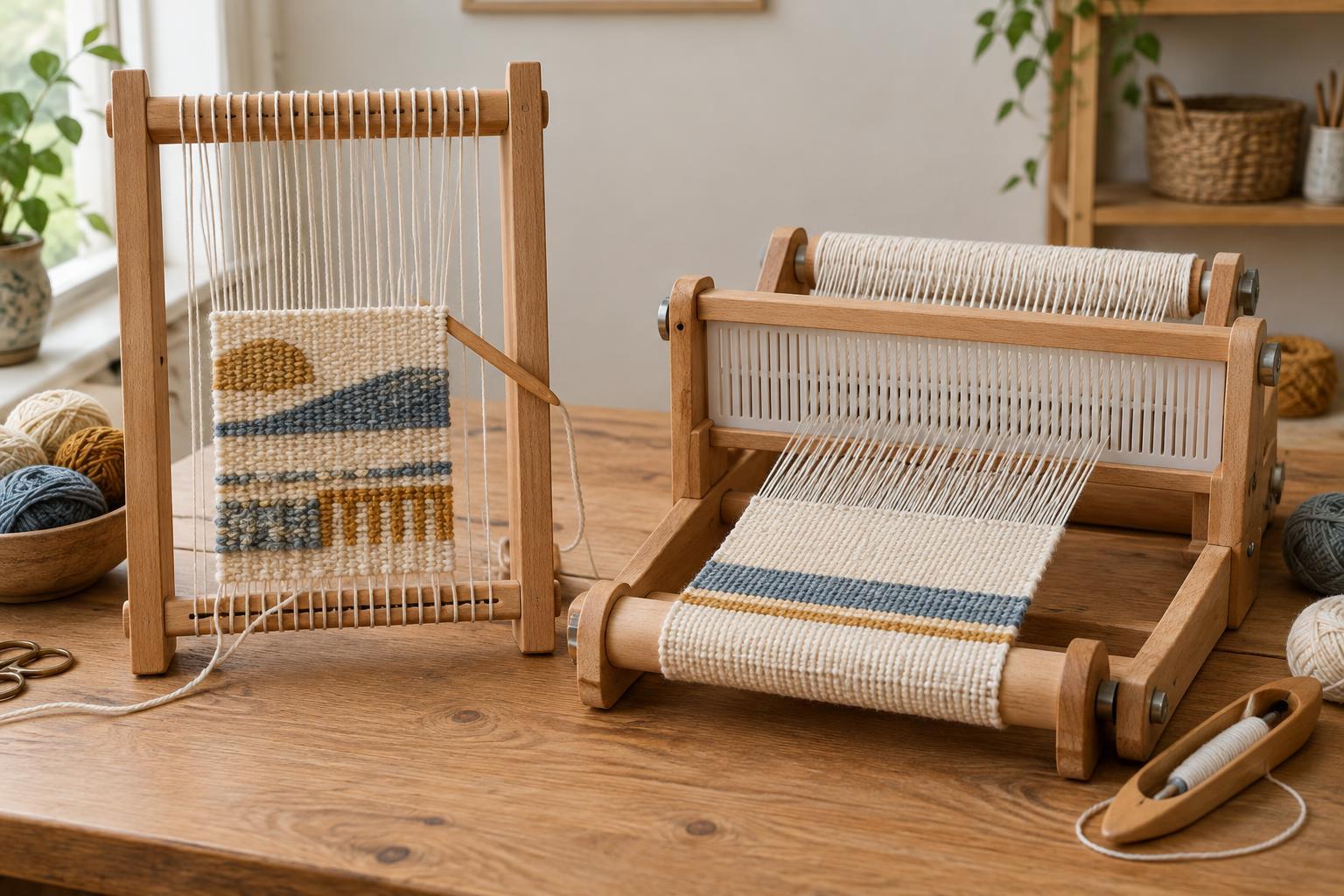
Every woven piece starts with a warp: threads held lengthwise under tension. The weft passes across them, alternately going over and under. A simple frame loom holds the warp on a fixed frame. To make each row, you can guide the weft over and under the threads by hand, or use a shed stick or other simple aid to lift groups of warp threads.
A rigid-heddle loom adds a part called a heddle, which has alternating holes and slots. Some warp threads pass through holes and others through slots. Raising or lowering the heddle separates them into two groups, creating a space, or shed, for the weft to pass through. The heddle also serves as a beater to push each new row into place. Both looms still ask you to control tension and watch the edges, but the rigid heddle makes repeated plain-weave rows quicker to form.
What a frame loom makes approachable
A frame loom is well suited to small pieces you can see and handle as a whole: a wall hanging, a woven panel for a pouch, a coaster or a sample of yarns and textures. Its open surface makes it easy to place a colour in just one area, change weft materials or build a shape row by row. That makes it a welcoming way to explore tapestry-style weaving, where the weft is packed closely enough to cover much of the warp.
The trade-off is size and pace. On a basic frame, the amount of warp you can work on is limited by the frame and by how you attach the threads. Repeatedly passing a needle over and under individual threads can be slow, particularly if you want an even cloth rather than a textured picture. Frame looms vary, though: a frame fitted with a shed stick or other accessories may make some steps faster than a bare frame.
What a rigid-heddle loom makes approachable
A rigid-heddle loom is a practical choice for lengths of plain-woven cloth. Depending on the loom’s width and how much warp you wind on, a beginner might make a scarf, table runner, set of small cloths or fabric for a simple sewn project. Moving the heddle between its two positions gives you the alternating sheds needed for basic plain weave, so you can concentrate on a comfortable rhythm, consistent beating and tidy edges.
You can still experiment with colour stripes, different yarns and some hand-manipulated patterns. A rigid-heddle loom does not, however, produce every pattern automatically. More elaborate structures may require additional tools, extra steps or a different loom. It is also worth checking that a proposed yarn can pass comfortably through the heddle: very bulky or irregular yarn may rub or crowd the slots and holes.
Compare the setup as well as the finished object
A basic frame loom can be straightforward to understand. You secure the warp around the frame or to its top and bottom edges, space the threads and begin weaving. Keeping that spacing and tension even takes practice, but the parts are visible and easy to inspect. It can be a useful first loom if your main goal is to learn how individual warp and weft threads interact.
Warping a rigid-heddle loom involves more stages: measuring a suitable length of warp, threading the heddle and winding the threads on evenly. The process becomes more familiar with repetition, but it is worth allowing time for it on a first project. In return, many rigid-heddle looms can hold more warp than a basic fixed frame, allowing you to weave a longer piece before cutting it off. The exact capacity depends on the particular loom and yarn.
Choose a first project that suits the loom
For a frame loom, try a small rectangular panel with a few changes of colour or texture. Use a modest number of warp threads so you can clearly see each crossing. Leave enough warp at the ends to secure the piece when you remove it; cutting close to the weaving may leave too little to finish safely.
For a rigid-heddle loom, begin with a narrow plain-weave scarf or sample cloth in yarn that moves easily through the heddle. Weave a short test section before committing to the whole length. Check whether the weft is packed as closely as you want and whether the sides draw inward. Small adjustments are easier to learn on a sample than to correct across an entire project.
Neither loom is simply the beginner version of the other. Choose a frame if you want to compose a small surface thread by thread; choose a rigid heddle if you want to build a length of cloth through repeated plain-weave rows. Either one can teach the central skill: noticing how tension, spacing and each pass of weft change the fabric in your hands.