Start with the jaw shape
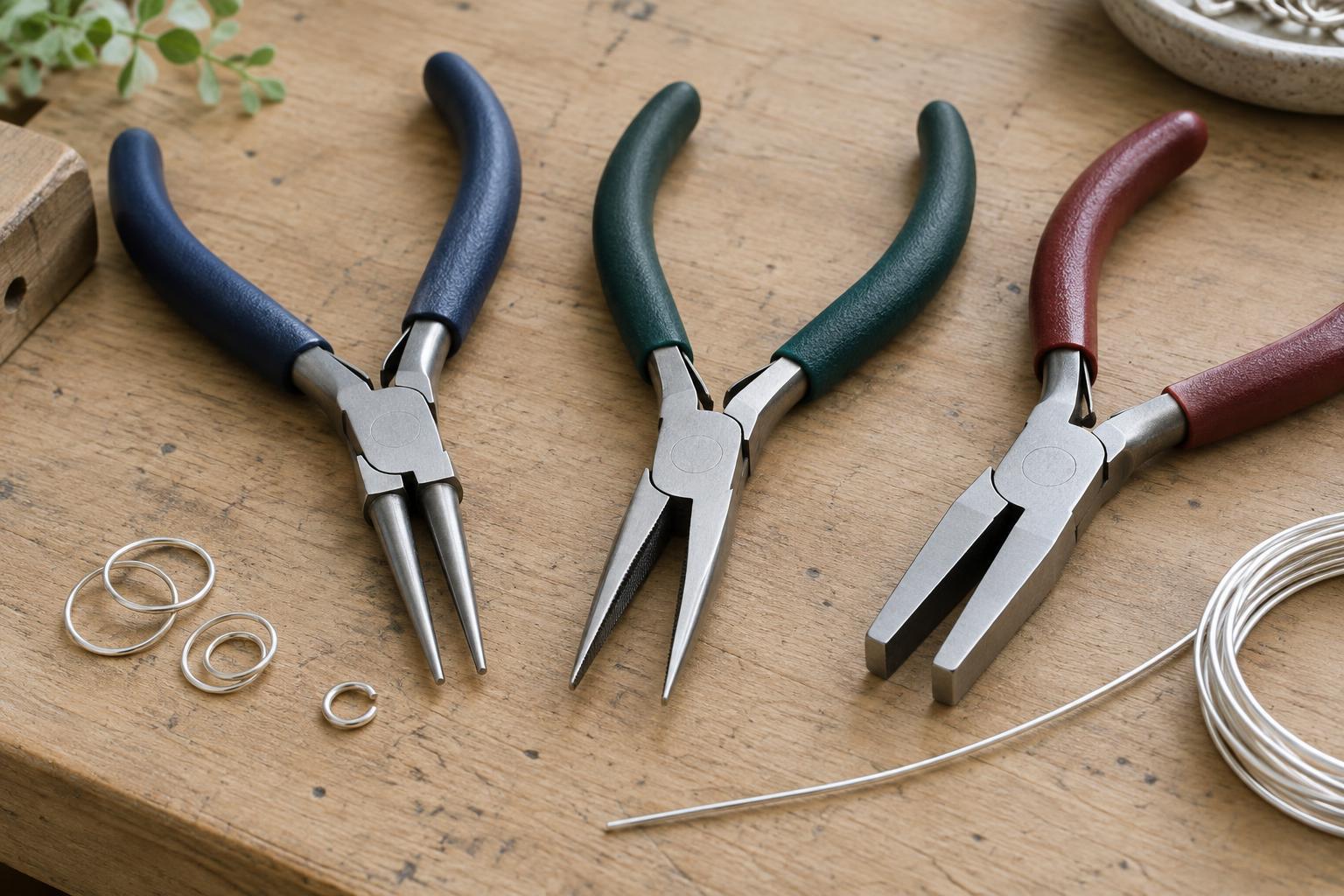
The easiest way to tell these pliers apart is to look at their jaws from the tip. Round-nose pliers have two smoothly tapered, cone-shaped jaws. Chain-nose pliers taper to narrow tips, but their gripping faces are flat. Flat-nose pliers also have flat gripping faces, usually with broader jaws that give more contact with the work. Those shapes determine whether a tool is best at making a curve, reaching into a tight space or holding a piece steady.
Jewellery-making pliers are often sold with smooth inner jaws rather than the serrations found on many general-purpose pliers. Smooth jaws reduce the risk of leaving a pattern on wire or metal findings, though they can still leave dents if squeezed too hard. Before buying or using a pair, check that the jaws meet evenly and that their edges feel smooth. A well-matched tool makes controlled movements easier than one that twists or slips in the hand.
Round-nose pliers make loops and curves
Use round-nose pliers when wire needs to wrap into a loop. Their tapered jaws let you choose the size of the curve: gripping near the tip produces a smaller loop, while gripping farther back produces a larger one. They are useful for forming the loop on an eye pin, shaping a simple wire link or starting a curved component. The wire bends around the jaw, so where you place it matters as much as how far you turn your wrist.
For loops that need to match, grip each piece of wire at roughly the same point on the jaws. A small piece of removable tape can serve as a placement guide. Work in controlled turns rather than trying to force the whole shape at once; you may need to release and regrip the wire to finish a loop. Round jaws create curves, but they offer little flat surface for securely holding a jump ring or making a sharp corner. Switch tools when the next step calls for either of those jobs.
Chain-nose pliers reach and position
Chain-nose pliers combine a narrow tip with flat gripping faces. The tips can reach a small loop or finding without covering much of it, making these pliers useful for positioning components and holding short lengths of wire. They can also make a defined bend where a loop begins: grip the wire at the intended point and bend the free end against the jaw. The bend will be more angular than one formed around round-nose pliers.
A common job is opening and closing a jump ring. Hold one side of the ring with chain-nose pliers and the other side with a second pair of suitable smooth-jaw pliers. Move the ends sideways past each other, then reverse that motion to close them. Pulling the ends directly apart can distort the ring’s circle. Work gently, especially with thin wire or plated findings, and check that the ends meet neatly when you are done.
Flat-nose pliers hold and align
Flat-nose pliers provide a broader grip than chain-nose pliers. That makes them useful for holding a component steady while another tool does the shaping, aligning a small section of wire or making a straight, deliberate bend. If a piece has a flat area that must stay flat, the wider jaws can support it more evenly than narrow tips. Flat-nose pliers also make a practical second tool for opening jump rings.
Their width is a limitation in cramped spaces: a broad jaw may block your view or press against a neighbouring bead or setting. In those situations, reach for chain-nose pliers instead. Neither pair is a substitute for round-nose pliers when you want a smooth, repeatable curve. Think of the three tools as a sequence: one pair holds the work, another forms the shape, and a narrow pair helps position or close the finished connection.
Choose a light grip and the right tool
Test a new movement on spare wire before working on a finished piece. Soft wire can mark easily, while stiffer wire may need more effort to bend; neither benefits from crushing pressure. Grip only as firmly as needed to keep the work from slipping, and reposition the pliers instead of forcing an awkward angle. If protecting a visible surface is especially important, try your method on a scrap of the same material first. Protective jaw covers may help in some tasks, but they also change how precisely the jaws grip.
Keep these pliers for gripping and shaping rather than cutting wire; use an appropriate cutter for that job. Wipe the jaws after use and inspect them for rough spots that could transfer marks to future projects. With a little practice, choosing between the three becomes straightforward: round-nose for curves, chain-nose for precise access, and flat-nose for broad, steady support.