Two ways to join leather
A seam does more than hold the pieces of a wallet, cardholder or bag together. Its holes, thread and placement also affect how the edge looks and how it responds to use. Saddle stitch and machine stitching are common ways to sew leather, but the names describe how the thread passes through the material, not a guaranteed level of quality.
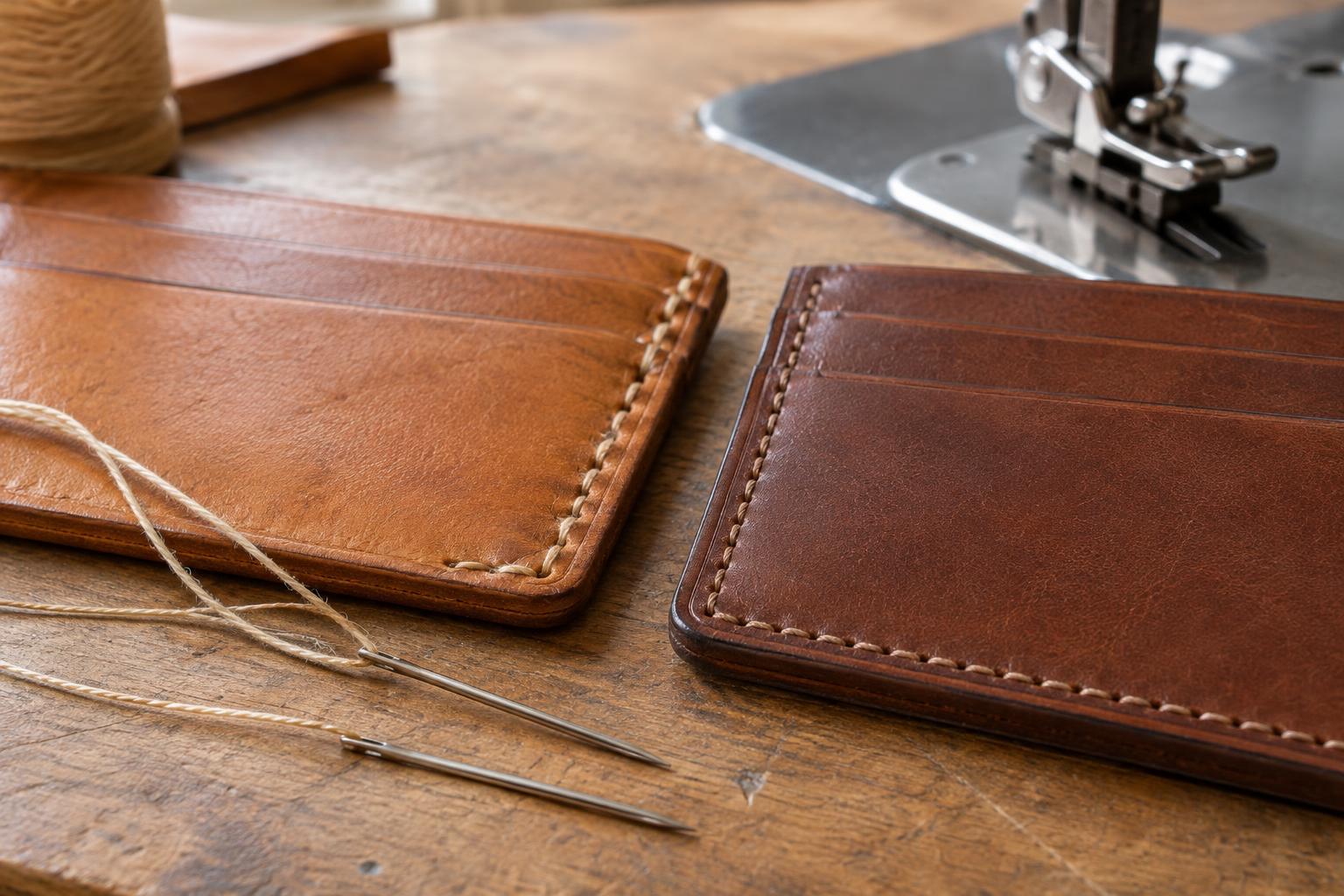
Saddle stitch is sewn by hand with a needle on each end of a single length of thread. The maker passes the needles through the same series of holes from opposite sides, drawing the thread snug after each stitch. Many sewing machines used for leather make a lockstitch instead: an upper thread passes through the material and interlocks with a separate bobbin thread below. Machine stitching is not one single method, so it is worth knowing which stitch is being compared.
How the stitches look and behave
On a neatly saddle-stitched edge, the stitches may sit at a consistent slant, especially when the holes have been made to encourage that angle. The slant alone is not proof of hand sewing. Hole shape, thread choice and the way a machine feeds the leather can also influence appearance. Likewise, a nearly straight-looking line does not necessarily indicate a poorly made seam.
A lockstitch often looks slightly different on its two sides because the upper and bobbin threads meet within the leather. When the machine is set up well for the material and thread, that meeting point is less visible from either face. A saddle stitch has no bobbin thread, though its two sides may still differ according to hole shape and sewing technique.
If one stitch is cut, neither type should be assumed to fail immediately or remain intact indefinitely. The crossing threads in a saddle stitch can help limit how easily damage travels along a seam. A lockstitch may loosen or pull out if a thread breaks and the seam is worked, but its behaviour depends on thread, tension, stitch length and use. The practical response to a damaged seam is the same in either case: avoid pulling at loose thread and repair it before more stitches are stressed.
What matters more than the label
Stitch type is only one part of a durable leather seam. Look at how far the holes sit from the edge, whether they are evenly spaced, and whether the thread lies snugly without cutting into the leather. Holes placed too close together or too near a thin edge leave less material between them. Excessive tension can make a seam look tight at first while puckering or weakening the leather around the holes.
The seam also needs to suit the accessory. A folded cardholder edge, a bag gusset and a strap attachment carry different loads. Reinforcement, seam layout and the direction of pull can matter more than whether the sewing was done by hand or machine. A carefully planned machine-sewn seam may serve its purpose better than a poorly placed saddle stitch, and the reverse can be true. Inspect the whole construction rather than treating one visible detail as a verdict.
Why makers choose one or the other
Hand saddle stitching gives a maker direct control around short runs, curves and awkward assemblies. It takes time, especially when holes are prepared individually, but it can be a practical choice for small pieces or areas that are difficult to feed through a machine. Machine stitching is well suited to repeatable seams and can make long runs more efficient. Neither choice, by itself, tells you how much attention was paid to cutting, edge finishing or assembly.
Repair is worth considering too. An accessible hand-sewn seam may be relatively straightforward to restitch along its existing holes, provided the leather remains sound. Machine-sewn seams can also be repaired, sometimes by hand. Reusing holes avoids making unnecessary new perforations, but damaged leather, adhesive or hidden layers may complicate either job. For a valued accessory, ask a repairer to assess the seam rather than pulling it apart to investigate.
Choosing and caring for a stitched accessory
When comparing pieces, gently examine both sides of an accessible seam. Check for skipped stitches, loose loops, uneven tension and holes that appear to tear toward the edge. A regular line is reassuring, but small variations do not automatically indicate weakness. Pay particular attention where a pocket opens, a strap joins the body or a corner bends repeatedly.
For everyday care, avoid overfilling pockets or pulling a bag by a part not designed to carry its weight. Keep sharp objects from catching exposed thread, and let damp leather dry away from direct heat. If a seam begins to open, stop stressing that area and arrange a repair while the original holes and surrounding leather are still usable. The best seam is not simply the one with the more appealing name: it is one whose stitching, materials and placement work together for the object’s intended use.