Start with the cut, not just the material
The best cutting tool depends on the shape you need, the thickness of the material and how much control you have over it. A long straight cut through cotton calls for a different approach from a small opening in cardstock or a curve in leather. Before cutting, ask whether the material lies flat, stretches, frays or shifts under pressure.
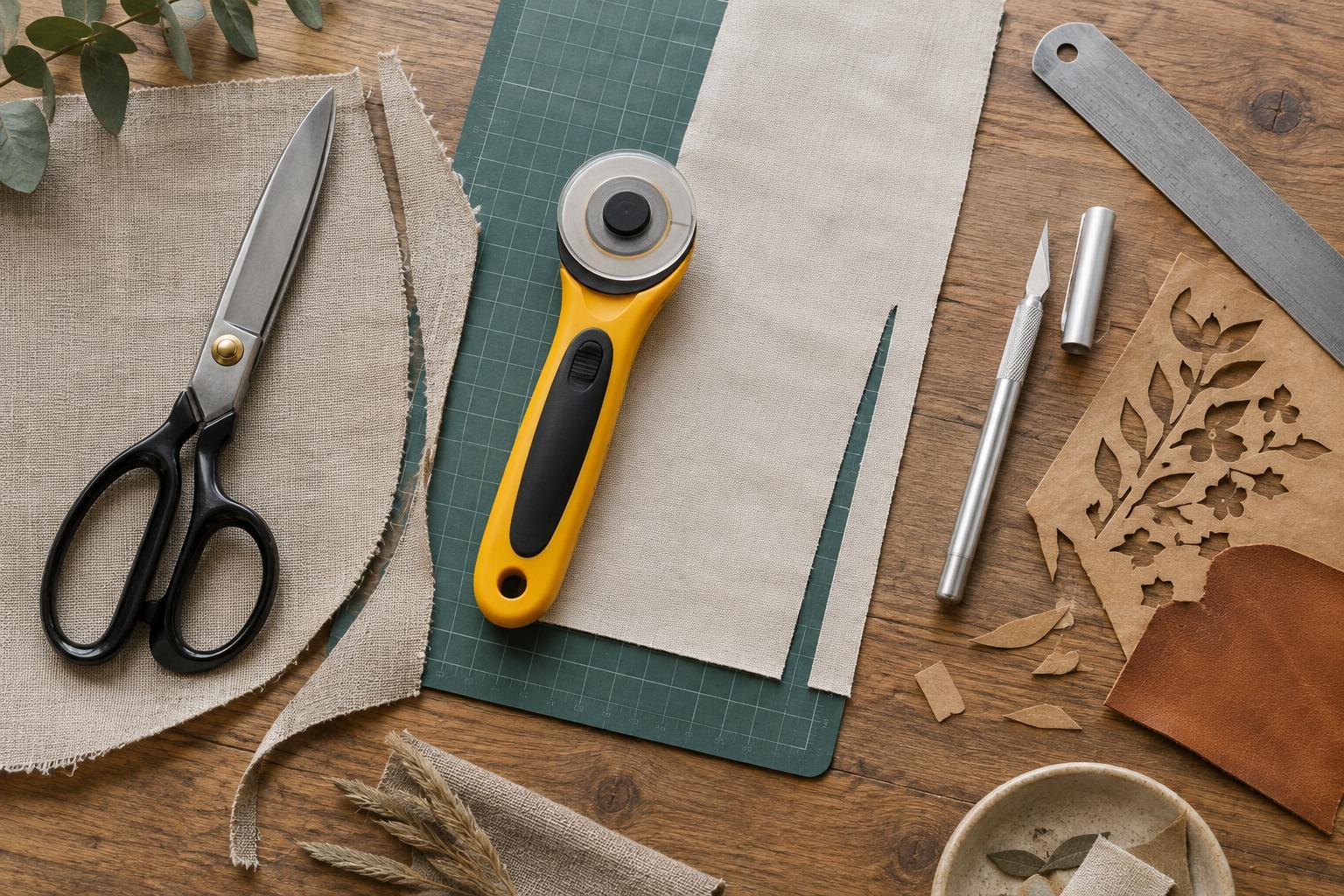
As a starting point, scissors are versatile for freehand shapes and small adjustments. Rotary cutters excel at long lines and repeated fabric cuts when used with a ruler and mat. Craft knives give precise control over internal openings, corners and cuts guided by a straightedge. None is best at everything: a tool that makes one edge clean may make another awkward or unsafe.
Whatever you choose, test a cut on an offcut when possible. Check both faces and the edge of the material. If the cut drags, tears or needs excessive force, the blade may be dull, the layers may be too thick, or another tool may be a better fit.
When scissors give the most control
Scissors suit curved outlines, notches, thread ends and cuts that need frequent changes of direction. Dressmaking shears have long blades that help cut fabric in smooth strokes, while small sharp scissors are useful for close trimming. Keep fabric as flat as possible on the table rather than lifting it high while cutting; lifting can distort the shape, especially in light or loosely woven cloth.
For paper and cardstock, ordinary craft scissors work well on outer edges and simple shapes. If you also cut fabric, keep a separate pair of shears for it. Paper and abrasive materials can dull an edge, making later fabric cuts snag or chew rather than slice. Small scissors can cut thin leather or felt, but thicker pieces may resist the blades and leave a compressed or uneven edge.
Scissors are less convenient for long, ruler-straight cuts and for openings entirely inside a piece. They can also push a flexible material ahead of the blades. If that happens, try a shorter cut, secure the material, or switch to a tool that cuts against a mat.
Where rotary cutters earn their place
A rotary cutter rolls a circular blade across material laid on a self-healing cutting mat. Paired with a suitable ruler, it is especially useful for straight strips, repeated shapes and layers of stable woven fabric. It can also follow broad curves, though tight corners are usually easier with scissors or a knife. Keep the ruler firmly in place and cut away from your supporting hand.
Rotary cutters can work on some felt, thin leather and other sheet materials, but results vary with thickness and density. A blade may fail to reach through a thick stack, leaving joined fibres underneath; forcing it can make the cutter slip. Try fewer layers and inspect the cut before moving the material. A sharp blade is important: repeated passes with a dull one often shift the layers or roughen the edge.
Use a mat intended for rotary cutting, and check that it is large enough to support the full stroke. A household tabletop or a mat designed only for light knife work may not provide the same protection. Retract or cover the blade whenever you pause.
Choose a craft knife for detail and inside cuts
A craft knife is useful for crisp corners, small windows in paper or cardstock, and shapes that begin away from the outer edge. With a metal straightedge, it can produce neat straight cuts in card, thin leather or other firm sheets. Place the material on an appropriate cutting mat and hold the straightedge so your fingers stay clear of the blade’s path.
Instead of trying to cut thick material in one forceful stroke, make several light passes along the same line. This tends to give better control and reduces the chance of the blade wandering. Turn the work, rather than twisting your wrist into an awkward angle, when approaching a corner. For soft or stretchy fabric, a knife can pull fibres unless the material is securely supported; scissors or a rotary cutter may be more predictable.
Choose a blade shape and size that suit the task, and replace blades that tear or require extra pressure. Dispose of used blades in a rigid container, not loose in a bin. A knife is precise, but that precision depends on a stable work surface and an unobstructed cutting path.
A quick material-by-material choice
For woven fabric, reach for sharp fabric shears for garment curves and rotary cutters for straight strips or repeated pieces. For knits, use sharp scissors or test a rotary cutter on a single layer; avoid stretching the fabric as you work. Felt often cuts well with scissors for shapes, while a rotary cutter may be efficient for straight edges if it cuts fully through.
For thin, supple leather, scissors can handle simple curves and a sharp knife can help with guided lines or internal details. On thicker or firmer leather, a knife used in controlled passes may give a cleaner result than forcing scissors. For paper, choose scissors for outer silhouettes and a knife for windows and sharp corners; a rotary cutter can speed up repeated straight cuts if the ruler and mat hold everything steady.
These are starting points, not fixed rules. Material thickness, blade sharpness and the finish you want all matter. Mark the cut clearly, support the work, and test on a spare piece. The right tool is the one that makes the intended edge cleanly without requiring you to push beyond comfortable control.