What a loop does
A wire loop turns a straight length of wire into a connection point. It might join a bead to an earring finding, attach a charm to a chain, or link several components in a necklace. In handmade jewellery, two common choices are the simple loop and the wrapped loop. Both can form an attractive, functional connection, but they are made differently and cannot always be used interchangeably.
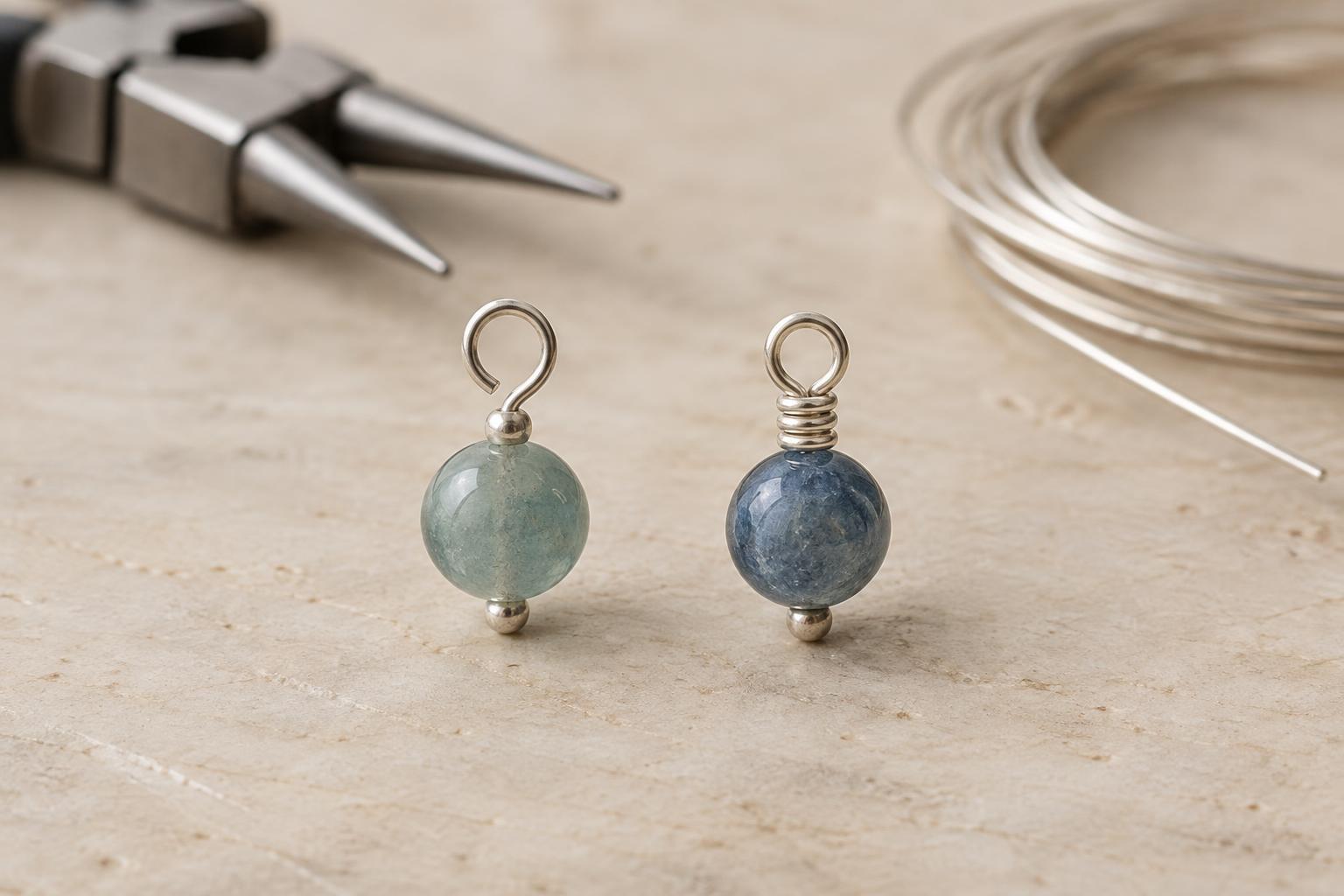
A simple loop is a circle or near-circle bent at the end of a wire. Its tail stops where it meets the wire stem, so the loop can usually be opened and closed. A wrapped loop has a wire tail coiled around the stem beneath the loop. That coil closes the connection more permanently. Neither style is automatically better: the useful choice depends on the design, the wire, and whether the maker may need to reopen the link.
How a simple loop is made and used
To make a simple loop, a maker bends the wire above a bead or other component, leaves enough space for the turn, trims the end, and curves it with round-nose pliers. The aim is a smooth loop that meets the stem without a noticeable gap. Consistent loops often come from placing the wire at the same point on the tapered jaws of the pliers each time. This is especially helpful when making a row of matching bead links.
Simple loops suit designs that may need adjustment or repair, because a link can generally be opened without cutting it. They also keep the area above a bead compact. The trade-off is that a poorly closed loop can separate if it catches or is pulled. When joining components, open the loop by twisting one side gently forward and the other backward, then return it to its original alignment. Pulling the circle outward can distort its shape and make it harder to close neatly.
How a wrapped loop differs
A wrapped loop begins with a bend and a circular opening, but the maker leaves a longer tail. After forming the loop, they wind that tail around the wire stem, usually several times, and trim the excess. The final cut end should sit close to the coil rather than sticking out. Because the tail is secured around the stem, a wrapped loop is not intended to be opened for assembly in the way a simple loop is. Any component that cannot open must be placed in the loop before the wrapping is completed.
Wrapped loops can be useful for dangling components that move often or for connections where the maker wants a closed wire link. Their coils also become a visible design detail. They take more wire and more room above a bead, so proportions matter: an oversized wrap can overwhelm a small component. Wire that is too stiff for the chosen thickness may be difficult to coil evenly, while very soft wire may need extra care to keep the loop’s shape.
Choosing between the two
Start with how the pieces must be assembled. If you need to connect and disconnect links while arranging a design, simple loops offer flexibility. If the link should remain closed once made, a wrapped loop may be more suitable. Also consider the space available around bead holes, caps, and neighbouring components. A wrap needs a straight section of wire below the loop; if it is crowded against a bead, the coil can look cramped or press on the bead.
The weight and movement of the finished piece matter too, although no loop style can compensate for unsuitable wire or a weak finding. A light decorative strand may work well with carefully closed simple loops. A freely swinging charm may benefit from a wrapped connection. Makers sometimes combine both styles in one piece, using simple loops for adjustable sections and wrapped loops for permanent drops. The result should look intentional and remain comfortable to wear.
What to look for in finished jewellery
Examine the connection from the front and side. A tidy simple loop is round enough to move freely on its adjoining part, with its cut end meeting the stem closely. A tidy wrapped loop has a recognisable opening and snug coils that do not cross awkwardly or leave a sharp tail exposed. Matching links need not be mechanically identical, but large differences in loop size can make a strand hang unevenly.
Gently check that adjoining parts move as intended without forcing them. If a simple loop has opened, it may be possible to realign and close it with suitable pliers; repeated bending, however, can weaken wire. A wrapped loop with a protruding cut end may need careful finishing rather than more twisting of the whole component. When making either style, protect your eyes while cutting wire and collect the small offcuts. Good loop work is not just decorative: it helps a piece hold together and feel pleasant against clothing and skin.