Two ways to join metal
A connection is the place where separate parts of a piece of jewellery meet: a ring band closes, a setting attaches to a pendant, or a link joins a chain. Metalworkers often make that connection with solder and heat, or with a cold technique that does not require heating the assembled parts. Neither approach is automatically stronger, more skilful or more valuable. The result depends on the design, materials and quality of execution.
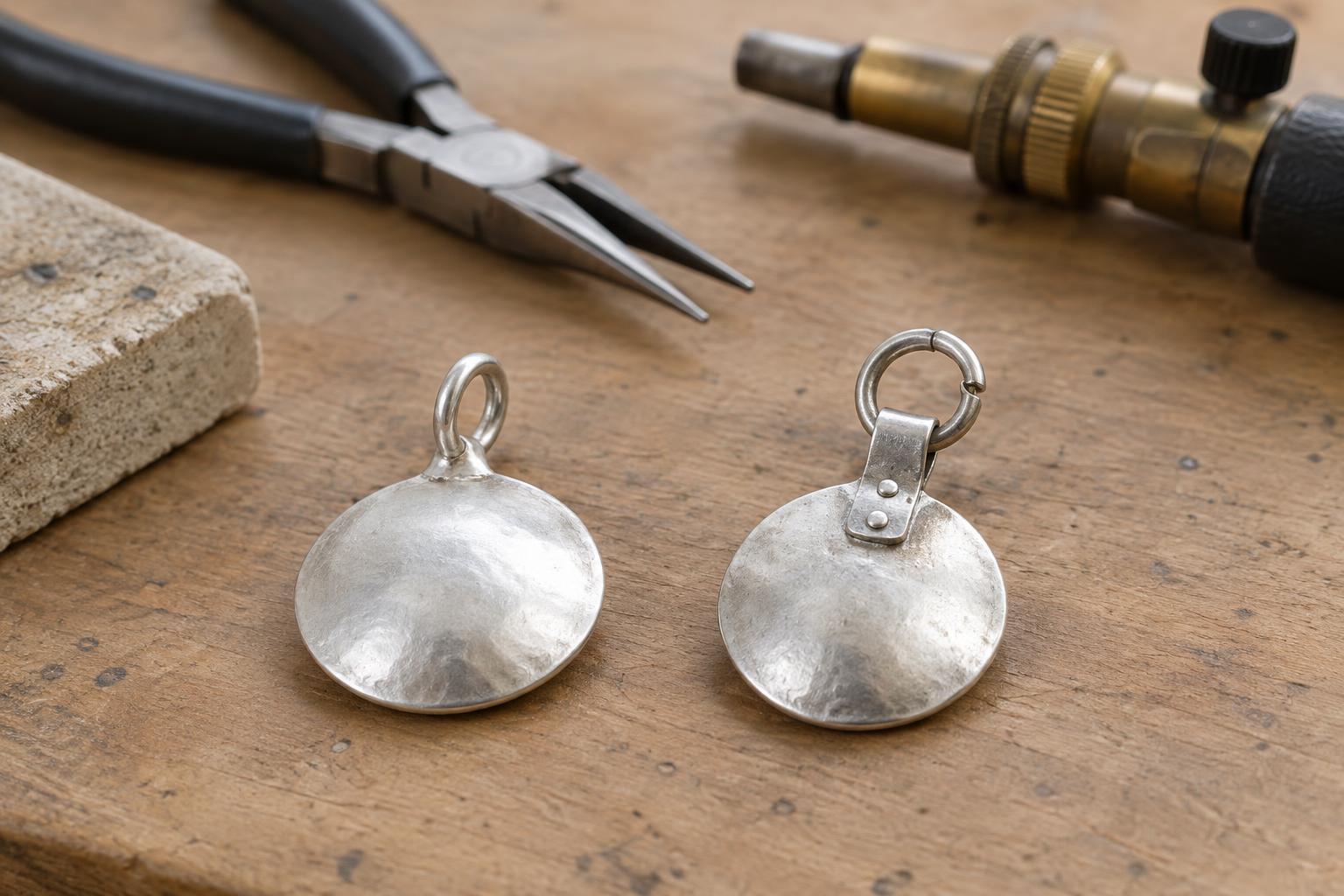
In jewellery making, soldering commonly means heating closely fitted metal parts until a compatible filler metal flows between them. The parts themselves are not intended to melt. A well-made joint can look nearly continuous after finishing. Cold connections instead hold parts together by their shape or by a separate mechanical component. Rivets, folded tabs, wire wraps and some jump-ring assemblies are familiar examples. These joints often remain visible, and their visible structure can be part of the design.
What a soldered seam can do
Soldering is useful when a maker wants a compact join without an added fastener. It can close a ring band, attach a post to an earring, or secure elements of a metal setting. To make a sound seam, the joining surfaces need to meet closely and be prepared so solder can flow where it is needed. A large gap filled with solder is not the same as a well-fitted joint.
The heat involved affects the order in which a piece can be assembled. Stones, adhesives, coatings and heat-sensitive materials may need to be added after soldering, removed before a repair, or protected by a method suited to the particular piece. Different metals and solders also behave differently under heat. Although a finished seam can be discreet, an obvious line is not necessarily a defect: some makers leave joins visible or use solder as a deliberate detail.
The word “solder” can describe different filler metals and working temperatures. A low-temperature soft solder should not be assumed to perform like the higher-temperature joins commonly used in precious-metal jewellery. Appearance alone rarely tells you exactly which material or method was used.
What cold connections make possible
A cold connection can bring together materials that would be difficult to heat as one assembly, such as metal beside a finished coating, a delicate found object or a component that cannot easily be removed. It can also create movement. A jump ring between a pendant and chain allows the pendant to swing; a riveted element may rotate if the joint is designed with enough clearance.
Mechanical joins need careful planning. A rivet passes through prepared holes and is formed at its ends to retain the parts. A tab folds over an edge, while a wire wrap holds an element by encircling it. Their security depends on details such as fit, metal thickness and whether the parts can pull, twist or wear against one another. A cold joint is not automatically easy to take apart: opening a folded tab or removing a rivet can mark or damage the work.
Cold connections are also expressive. Repeated rivet heads can create a rhythm across a surface, while a wire wrap can make the path of the maker’s hands legible. Those details need not be hidden to be considered well finished.
How to read the construction
When examining a piece, look first for where force travels. On a pendant, the bail and its attachment carry the weight. On a bracelet, links and clasp connections face repeated movement. Look for closed seams, fully seated rivets and tabs that grip without sharp projecting edges. A jump ring should have ends that meet cleanly; a visible gap may let a fine chain or loop escape.
These clues do not provide a complete test of durability. A polished solder seam can conceal poor fit, while a prominent rivet may be precisely made. Gently checking for unexpected movement is more useful than trying to bend a joint to prove its strength. If an attachment shifts, catches on fabric or appears to be opening, stop wearing the piece until it can be assessed. For a purchase or repair, it is reasonable to ask which connections are soldered, which are mechanical and whether any part is intended to move.
Choosing and caring for a joined piece
Choose by function as well as appearance. A smooth soldered join may suit a compact form that sits close to the skin. A rivet or link may suit a design that needs articulation, mixed materials or a clearly visible method of assembly. Many pieces use both: a soldered setting might hang from a chain through a jump ring. The strongest choice is the one suited to the particular load and materials, not a rule that one technique always wins.
For everyday care, avoid pulling on a pendant, charm or earring by its smallest connector. Store pieces so chains do not snag on raised tabs or wire ends, and check frequently handled joins for changes in fit. Cleaning methods should suit every material in the piece, including stones, coatings and adhesives. If a joint fails, keep any loose components and consult a jeweller or skilled repairer rather than applying household glue or heat; a lasting repair depends on understanding how the original connection was made.