Two ways colour becomes part of a ceramic surface
Underglaze is a colour-bearing material used to make marks or cover areas of a ceramic piece, often beneath a later coat of clear glaze. Glaze is a coating that melts and bonds to the ceramic during firing, creating a glassy surface. Glazes may be clear, translucent or opaque, and they can carry colour of their own. The names describe their roles, not simply whether one looks matte and the other looks shiny.
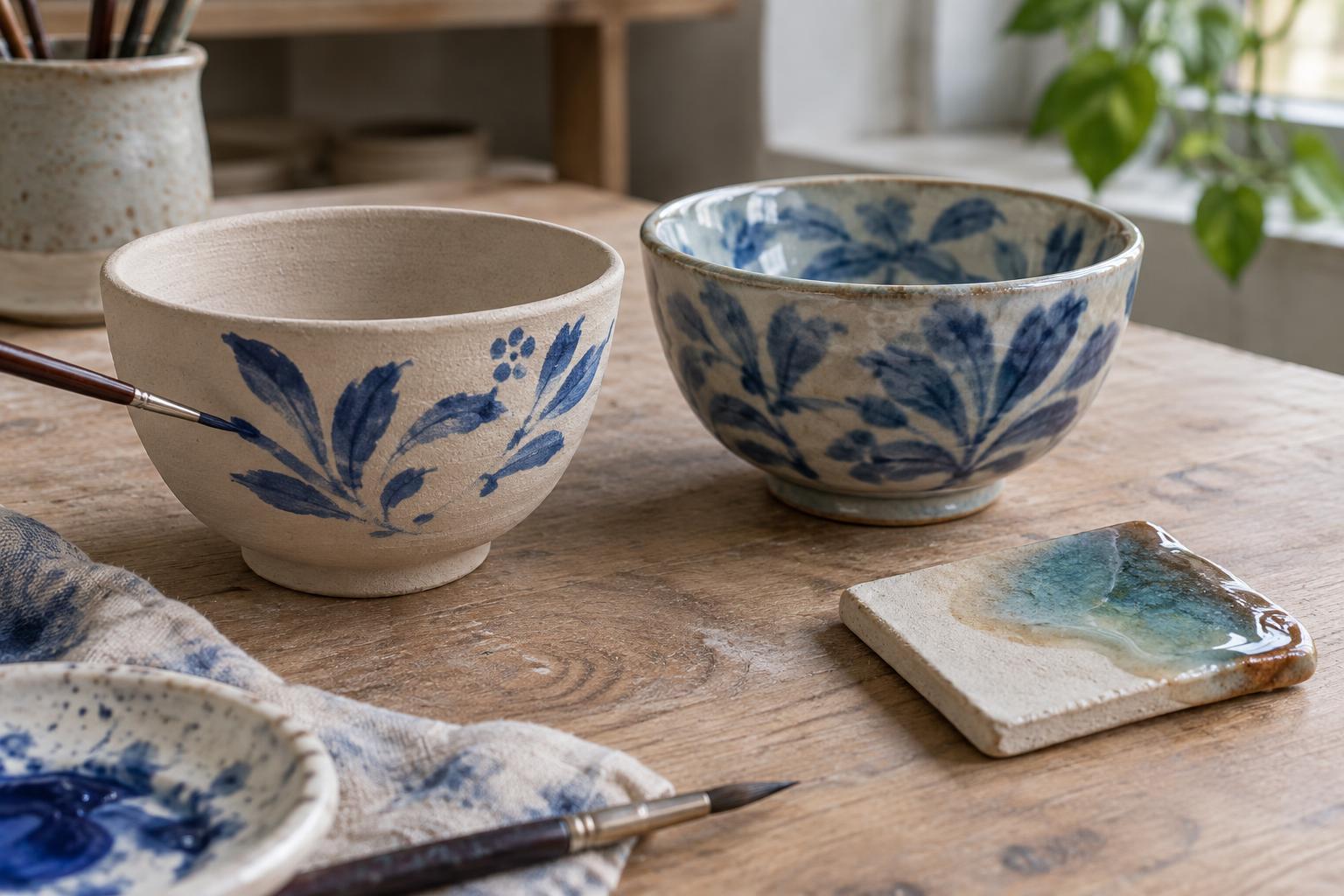
A potter might paint a blue motif with underglaze, then cover it with clear glaze. Another might dip the whole object in a coloured glaze, letting the coating supply both colour and surface finish. Some pieces combine the two: an underglaze design remains visible through a transparent glaze, or appears against an area of coloured glaze. Knowing which layer provides the colour helps explain the choices behind the finished object.
When underglaze is applied
Underglaze can be applied at more than one stage. Depending on the product and the intended effect, a maker may brush, sponge or draw it onto unfired clay that has dried to a suitable stage, or onto a piece that has already been bisque-fired. Bisque firing turns fragile dried clay into a more durable, porous ceramic. Its absorbent surface can make decorating and subsequent glazing easier to handle.
On clay, underglaze can form part of a design that responds to the shape as it is made. On bisque, the firm surface offers a different kind of control for painted lines and repeated patterns. Neither approach is universally better. The clay body, underglaze formulation and firing schedule all matter, so makers generally test materials together rather than assuming that a colour will behave the same way on every piece.
Despite its name, underglaze does not always have to sit under a final glaze. It can be left exposed for a drier-looking finish where that surface suits the object. An exposed underglaze surface should not, however, be assumed to have the same qualities as a properly fired glaze.
When glaze is applied
Glaze is commonly applied to bisque-fired ware, after the first firing and before a second firing that matures the glaze. A maker may pour, dip, brush or spray it, depending on the glaze and the object. In some ceramic processes, glaze is applied to unfired ware and the piece is fired once. The familiar bisque-then-glaze sequence is therefore common, but it is not the only route.
During the glaze firing, the coating changes substantially. A dry layer that may look powdery before firing becomes a bonded surface whose appearance depends on its ingredients, thickness, clay body and firing conditions. A clear glaze can deepen or shift the apparent colour of underglaze beneath it. An opaque glaze can conceal that decoration; a fluid glaze may soften a crisp-looking boundary. Small tests are useful when a precise colour or edge is important.
Glaze also has practical consequences beyond appearance. A suitable, well-fired glaze can provide a surface that is easier to wipe clean than porous, unglazed ceramic. That does not mean every glaze is appropriate for every use. Tableware needs materials and firing choices suited to contact with food, while a decorative wall tile or sculptural piece may be made with different priorities.
How to read the finished piece
Look first at where the colour sits visually. A fine drawn line visible beneath a continuous glossy surface may be underglaze covered by clear glaze. Colour that appears to belong to the overall glossy coating may come from the glaze itself. Bare clay beside a coloured area can offer another clue: an underglaze motif may retain the look of painted marks, while a coloured glaze often has its own thickness, pooling or variation at edges.
These are clues, not reliable proofs. A matte glaze may not look glassy, an exposed underglaze may look smooth, and several layers can produce similar appearances. Texture is not a safe test of whether an object is suitable for food or water. If use matters, ask the maker or seller about the materials and intended purpose rather than deciding from colour and shine alone.
The useful distinction is one of sequence and function: underglaze usually establishes decoration before a potential glaze layer, while glaze forms the fired coating that may protect, reveal, alter or supply the colour. Once you recognise those separate decisions, a ceramic surface becomes easier to appreciate without needing to know every detail of its recipe.