What the tanning method tells you—and what it does not
Tanning turns animal hide into leather that can be worked and used. Vegetable tanning uses tannins derived from plant materials, while chrome tanning uses chromium salts. Both methods can produce leather suitable for small accessories. Neither label, on its own, tells you whether a wallet or cardholder is well made.
A leather’s thickness, finish and treatment also shape how it behaves. A heavily finished vegetable-tanned leather may show less change with use than an unfinished one. Chrome-tanned leather can be firm rather than soft if it has been made and selected for that purpose. Treat the tanning method as a useful starting point, not a complete description of the material.
Feel and structure in everyday use
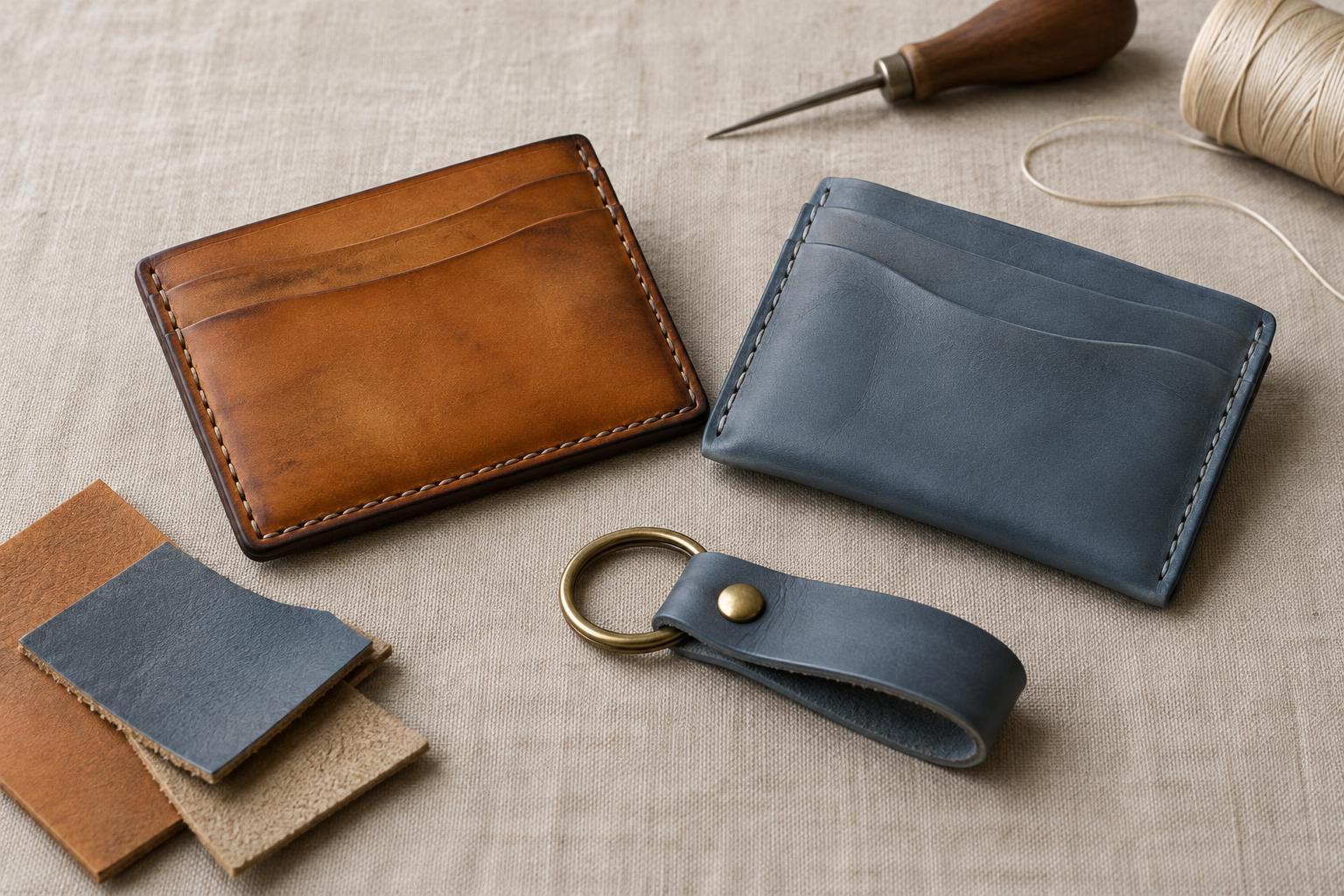
Vegetable-tanned leather is often chosen for accessories that benefit from a firm, structured feel. A cardholder made from it may feel quite stiff at first and gradually flex more easily as it is handled. That initial resistance can help a simple shape hold its form, though the result depends on the leather’s thickness and the way the maker has cut and assembled it.
Chrome-tanned leather is often more supple from the outset. This can suit a pouch, a folded wallet or a key case intended to feel soft in the hand. Suppleness is not always an advantage: a thin, soft leather may need a lining or reinforcement where a design must keep its shape. For either type, check how the finished accessory opens, closes and holds its contents rather than judging a loose piece of leather alone.
How colour and surface may change
Many vegetable-tanned leathers visibly change with handling and exposure to light. A pale, minimally finished piece may darken where fingers touch it most and develop marks that become part of its appearance. This gradual change is often called patina. It is worth deciding whether you would enjoy that evolving look before choosing a light-coloured accessory for daily use.
Chrome-tanned leather is often offered in a broad range of colours and finishes, some of which are designed to keep a more consistent appearance. It can still crease, scuff, fade or change with wear. A protective surface finish may resist minor marks, but it can also make scratches or wear at corners look different from those on an unfinished leather. No tanning method makes an accessory immune to use.
Construction details worth inspecting
Vegetable-tanned leather is commonly used for designs with exposed, polished edges. On a well-finished edge, the layers should look tidy and feel smooth rather than rough or sharp. Chrome-tanned leather is often finished with folded edges or an applied edge coating, although these are design choices rather than fixed rules. Look for coating that is even and flexible, without obvious gaps at bends.
Pay attention to the places that work hardest: card slots, fold lines, strap attachments and corners. Stitching should follow a consistent path, and any loose thread ends or separating layers deserve a closer look. These observations tell you more about the construction in front of you than a broad claim that one tanning method is inherently better.
Choosing and caring for an accessory
Choose for the way you plan to use the object. If you like a firm feel and visible changes from handling, a vegetable-tanned cardholder may appeal to you. If you prefer softness or a particular colour, a chrome-tanned option may be a better fit. When buying, ask what finish has been applied and whether the maker has specific care instructions; you cannot reliably identify a tanning method by colour or softness alone.
For either type, keep the accessory away from prolonged dampness and let it dry naturally if it gets wet. Wipe off surface dirt gently with a soft, dry cloth. Before using any cleaner or conditioner, check that it is suitable for the particular finish and test it on an inconspicuous area if possible. Avoid treating every mark as a problem to fix: some changes are ordinary wear, and aggressive cleaning may do more harm than the mark itself.