What makes enamel different from paint?
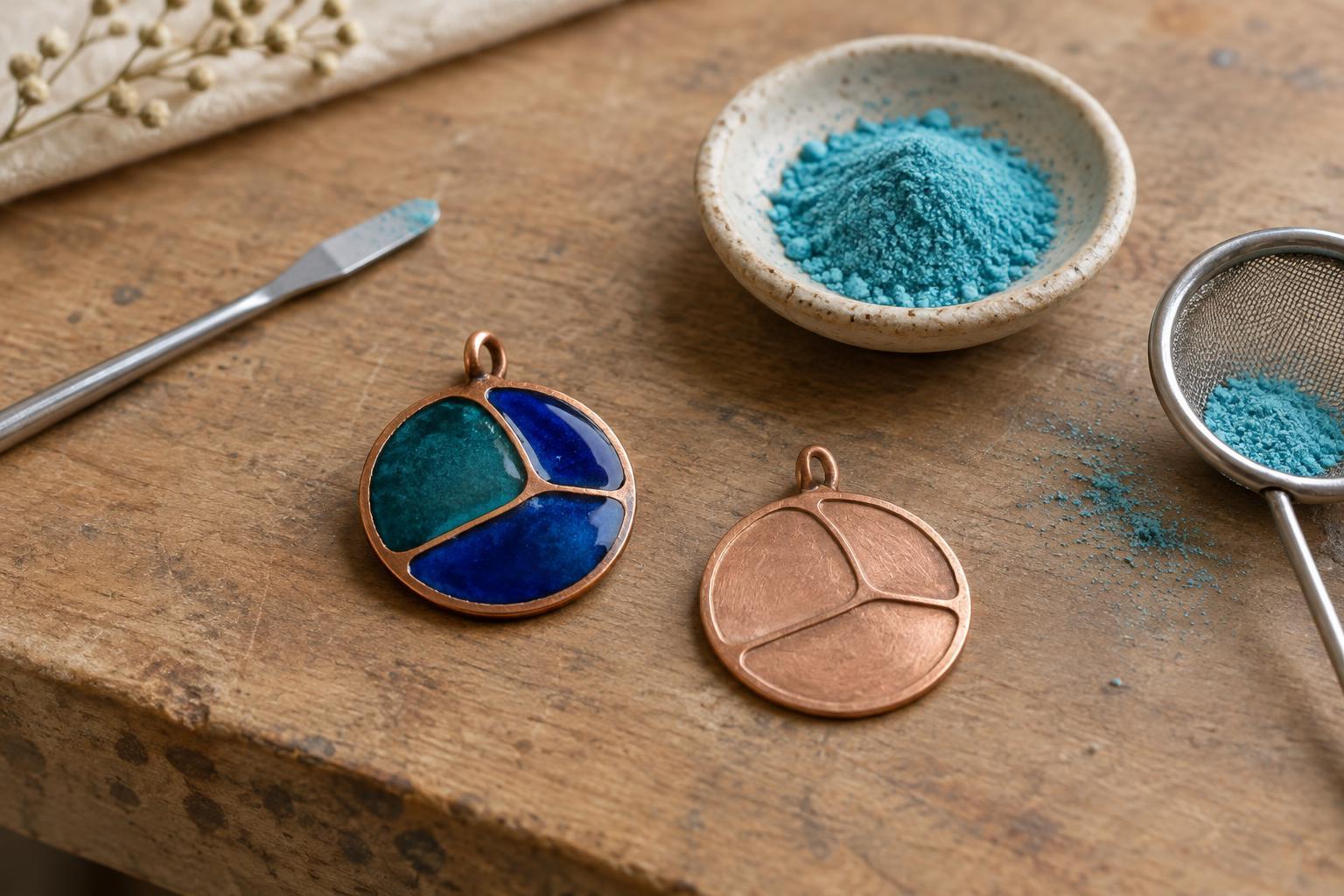
Vitreous enamel is glass fused onto a metal surface. It begins as finely ground glass, often mixed with water for application. When the piece is fired, the particles soften, flow together and form a continuous layer. As the piece cools, that layer becomes hard glass again. Pigments, colour-producing ingredients and the glass composition give enamels their varied appearances.
Unlike paint, enamel does not dry into a film held together by an organic binder. Its lasting surface forms through heat. That does not make it unbreakable: the glass can chip or crack if the object is struck or bent. The metal beneath remains important, both as a support and as a material that responds to heating and cooling.
How the glass attaches to metal
A sound bond starts with a suitable metal and a clean surface. Oils, polishing compounds and unwanted oxides can interfere with the way molten enamel spreads. A maker therefore prepares the metal before applying the powder. Copper, silver and gold are familiar bases for jewellery enamel, but each behaves differently during firing; not every enamel suits every metal.
During firing, the softened glass wets the prepared surface and settles against its contours. Adhesion depends on close contact at that interface, as well as on the particular glass and metal being used. The maker must also account for how each material expands when heated and contracts when cooled. If their behaviour is poorly matched, stress can lead to cracks, lifting or other failures, sometimes after the piece has left the kiln. A glossy surface alone does not prove that the bond underneath is sound.
From powder to finished surface
Enamel may be sifted onto a surface or applied as a damp mixture. The coating is dried before firing so trapped moisture does not disturb it. Heat in a kiln or from a controlled torch then brings the glass to the point where it fuses. The precise firing conditions depend on the enamel, metal, size of the object and intended effect. A maker may add and fire several thin layers rather than trying to build the full depth at once.
After cooling, the surface may be left as fired, ground level or polished. Some work is fired again to refine the finish or add detail. Each firing changes both glass and metal, so the sequence matters: a colour that works in one layer or firing may not behave identically in another. Making enamel reliably takes practice in preparing surfaces, controlling heat and judging when a layer has fused.
How enamel techniques shape the design
The same basic bond supports several decorative approaches. In cloisonné, thin metal wires define cells that hold different colours of enamel. In champlevé, recesses cut or formed in a metal surface contain the glass, leaving metal between the enamelled areas. Painted enamel uses finely applied material to create pictorial details. These terms describe how a design is constructed, not a guarantee of a particular age, origin or level of quality.
Enamel may be opaque, translucent or transparent. Transparent layers can reveal engraved texture or the colour of the metal below, while opaque layers conceal more of the base. On some pieces, enamel is also applied to the reverse, sometimes called counter-enamelling, to help balance stresses across a thin metal support. A bare reverse is not automatically a defect; its significance depends on the object's shape and construction.
What to look for and how to care for it
To examine an enamelled object, look at its edges and areas where glass meets exposed metal. An even surface and clear design boundaries can indicate careful application, but small variations may be part of handwork. Chips that expose metal, branching cracks and areas that seem to have separated from their base deserve closer attention. Distinguishing enamel from resin or another glossy inlay by sight alone can be difficult, especially in photographs.
Treat enamel as glass attached to metal: avoid impacts, bending and abrasive cleaning. Dust it with a soft cloth, and use a lightly dampened cloth for ordinary grime if the object can safely tolerate moisture; dry it afterwards, including around settings and joints. Avoid soaking a piece with unknown construction. If the enamel is loose or chipped, keep the fragments and consult a qualified repair specialist rather than trying to refire or glue the surface at home.