Start with the way you will use it
A wallet can look carefully made and still be awkward in daily use. Before judging its details, think about what it needs to hold: a few cards, folded notes, coins or receipts. A slim card holder and a billfold solve different problems, so assess each against its intended purpose rather than expecting every pocket to do everything.
If you can handle the wallet, open and close it several times without filling it. Notice whether it folds naturally and whether the layers lie reasonably flat. A new leather wallet may feel firmer than one that has been carried for months, but its layout should make sense from the start. Look inside as well as outside; construction details are often easiest to see at pocket openings and corners.
Check pocket fit without forcing it
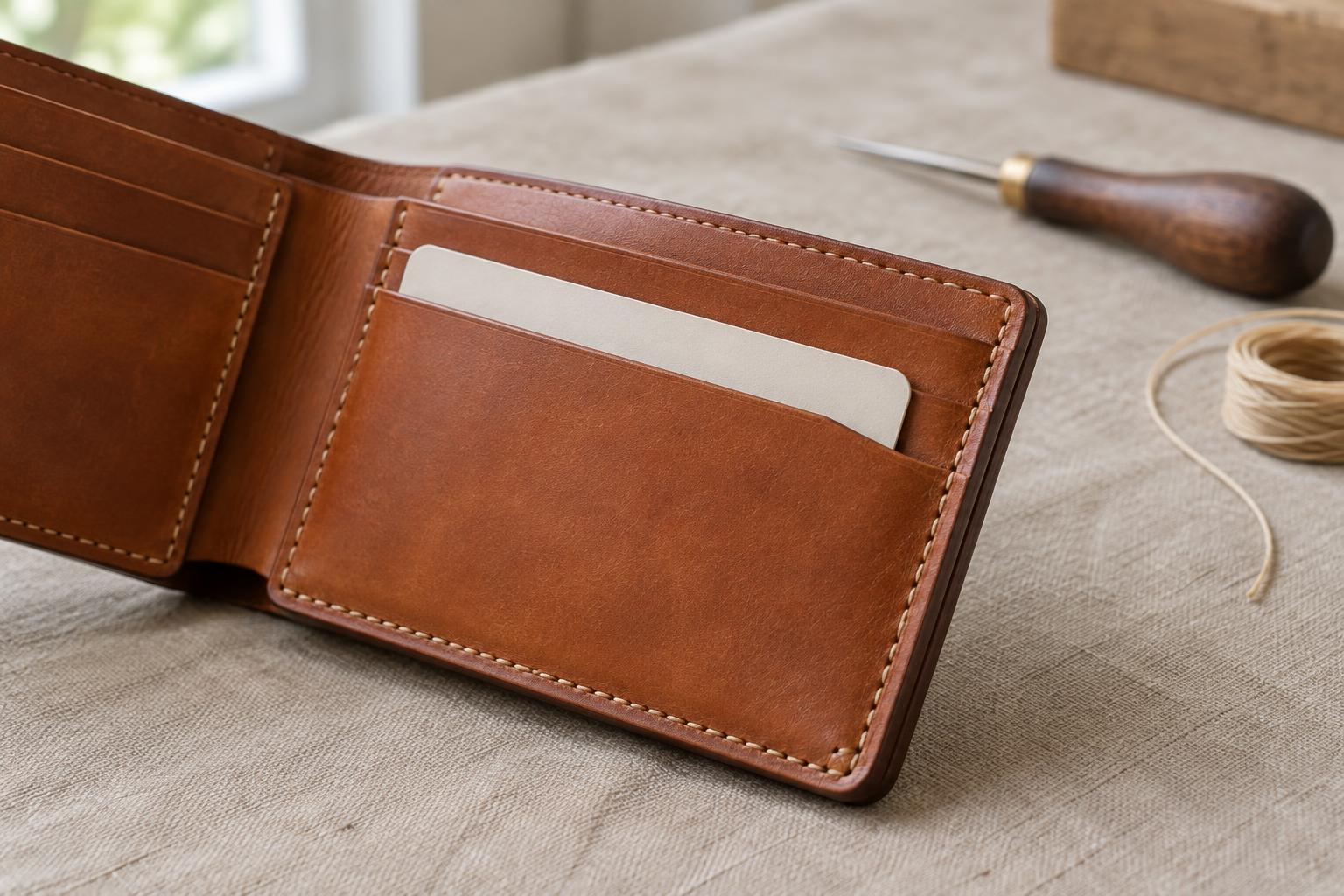
Bring a card you normally carry, if possible. It should slide into its intended pocket with light, steady pressure and stay there when you gently turn the wallet over. A pocket that grips so tightly that the card bends or catches at the opening may be frustrating to use. One that releases a single card too easily may not suit someone who carries only one card in that slot.
Test pockets individually before filling them all. Each added card changes the thickness of the wallet and may affect access to neighbouring slots. Check that your fingers can reach the cards you use most and that pocket openings do not collapse or roll as you remove them. Leather can soften with handling, but it is unwise to rely on a severely tight pocket becoming comfortable. For a billfold, check that notes fit without bunching at the fold; for a coin pocket, check that its closure works when the pocket contains a modest amount.
Follow the stitching around stress points
Stitches hold the layers together where pockets are pulled, corners flex and the wallet folds. Trace each seam with your eyes. The spacing should look reasonably consistent for the design, and the thread should sit securely without obvious loops, skipped sections or loose ends that catch on a finger. Slight variation can be part of handwork; what matters more is whether the seam appears sound and performs its job.
Pay particular attention to the top corners of card slots and the ends of short seams. These areas take repeated strain as cards go in and out. Gently flex the wallet as it would move in use, without tugging hard on a pocket. Look for layers separating, stitches pulling through the leather or thread that seems slack when the material bends. A decorative line of stitching is not a substitute for a secure join: check where the pocket is actually attached.
Read the edge finish, not just the colour
A cut edge may be smoothed and burnished, coated with edge paint, folded under or left relatively natural, depending on the leather and design. These approaches can all be appropriate. What you want to see is an edge that feels comfortable to handle and does not expose loose layers where a clean join is expected. Run a fingertip lightly along accessible edges, especially around the opening and fold.
On a burnished edge, look for a surface that feels smooth rather than fuzzy or sharply ridged. On a painted edge, check for obvious cracks, lifting or thick blobs at corners; a neat coating should follow the shape without obstructing a pocket. Folded edges should sit flat enough not to catch in use. Inspect the inside edges too. A polished outer perimeter tells you little about an unfinished pocket opening that rubs against cards.
Make a final, practical judgment
Small marks, grain changes and differences in sheen can occur in leather and do not, by themselves, tell you whether a wallet is well constructed. Likewise, a perfectly uniform appearance does not guarantee comfortable pockets or durable seams. Judge the whole object: does it hold your essentials, allow you to retrieve them easily and feel secure at the points you will handle most?
If you are inspecting a wallet you already own, avoid overstuffing it to make tight pockets loosen faster; that can put extra strain on seams and edges. Empty out accumulated receipts from time to time, and let a damp wallet dry away from direct heat. A useful wallet is one whose fit and construction work together in ordinary use, not simply one that looks impressive when empty.