Why the ends matter most
A leather strap carries a load along its length, but that load changes direction where the strap passes through a buckle or ring, or joins the body of a bag. At these points, the leather may bend sharply, rub against hardware and pull against a small group of stitches or rivets. A strap that feels substantial in the middle can therefore be weak at its ends.
Strength depends on more than leather thickness. The shape of the attachment, the amount of material left around holes, the fit of the hardware and the way the item is used all matter. A narrow shoulder strap on a lightly loaded bag faces different demands from a handle that is repeatedly lifted by one end. Looking closely at the attachment tells you more than judging the strap by its overall appearance.
Folded ends and the path of the load
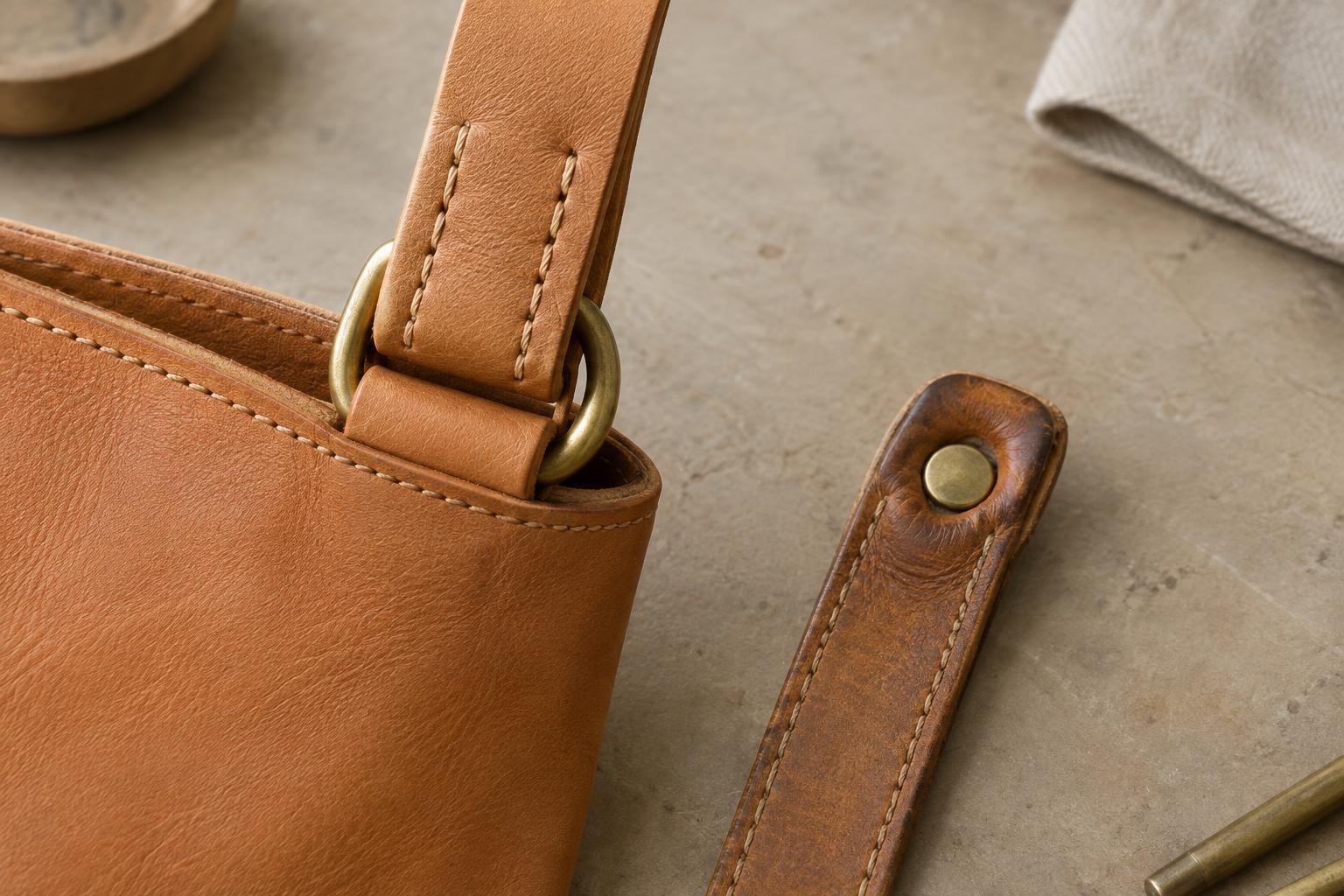
One common construction passes the strap through a ring, folds it back and secures the doubled section. This gives the maker room to place stitching or rivets away from the bend. A longer return also provides more space to spread the load, although length alone cannot compensate for poor placement or damaged leather. The fold should sit comfortably around the hardware rather than being forced into a tight crease.
The direction of pull is important. If the strap pulls straight away from the attachment, the fastening can share the load across the overlap. If it regularly pulls sideways, one edge or one fastener may take more strain. On a bag, check whether the strap can move naturally on its ring without twisting the leather at the fold.
Some attachments use a separate leather tab between the strap and the bag. The tab may spread force across a wider area of the bag body, provided that the material behind it is suited to the load. A neatly made tab attached only to a weak outer layer can still tear away.
What stitching and rivets can—and cannot—do
Stitching holds overlapping leather together, but every needle hole also removes a little material. Rows placed very close to an edge may leave a narrow strip that can tear. Closely packed holes can create a line along which leather splits, particularly if the area flexes repeatedly. Look for even stitches, sound thread and enough intact leather around the seam, rather than assuming that more stitches always mean a stronger joint.
Rivets can be useful where a compact fastening is needed, but their holes also interrupt the leather. A rivet set too close to an edge, or one that is loose and rotates, may concentrate wear around its hole. Several rivets are not automatically better than one: their spacing and the material surrounding them matter. Some attachments combine stitching and rivets, though the quality of each part remains more important than the number of techniques used.
At the bag body, a backing layer or reinforcement can help distribute force beyond the visible stitches or rivets. You may not be able to see what is inside a finished item. Where possible, feel whether the attachment area seems firm and whether it pulls or puckers unusually when the strap is lifted gently.
Hardware fit and visible signs of strain
A ring or buckle should give the strap enough room to move without pinching it. Hardware that is too narrow can crowd the leather into a sharp bend; a rough or damaged surface can abrade it over time. Very loose hardware may let a strap twist and load one edge more heavily. Examine the contact point for deep grooves, thinning, cracks or colour change that contrasts with ordinary surface wear.
At a stitched or riveted end, look for widening holes, lifted layers, broken threads and a fold that is beginning to split. Also check the material the attachment joins: a sound strap cannot make up for a bag panel that is tearing. Minor marks do not necessarily mean failure is near, but changes that grow with use deserve attention.
Care that protects the attachment
Avoid carrying more weight than an item appears designed to handle, and lift a bag by both handles when it has two. If a strap becomes wet, let it dry away from direct heat before putting it under heavy load. Keep grit out of folds and around hardware, where it can add abrasion.
Inspect attachment points periodically, especially on items used every day. A loose rivet, opening seam or developing tear is easier to address before the surrounding leather is damaged. Repair options depend on how the item was built and how much sound material remains; adding another fastener through weakened leather may not solve the underlying problem. The most useful habit is to look at how the load travels through the whole attachment, not just at the thickness of the strap.